
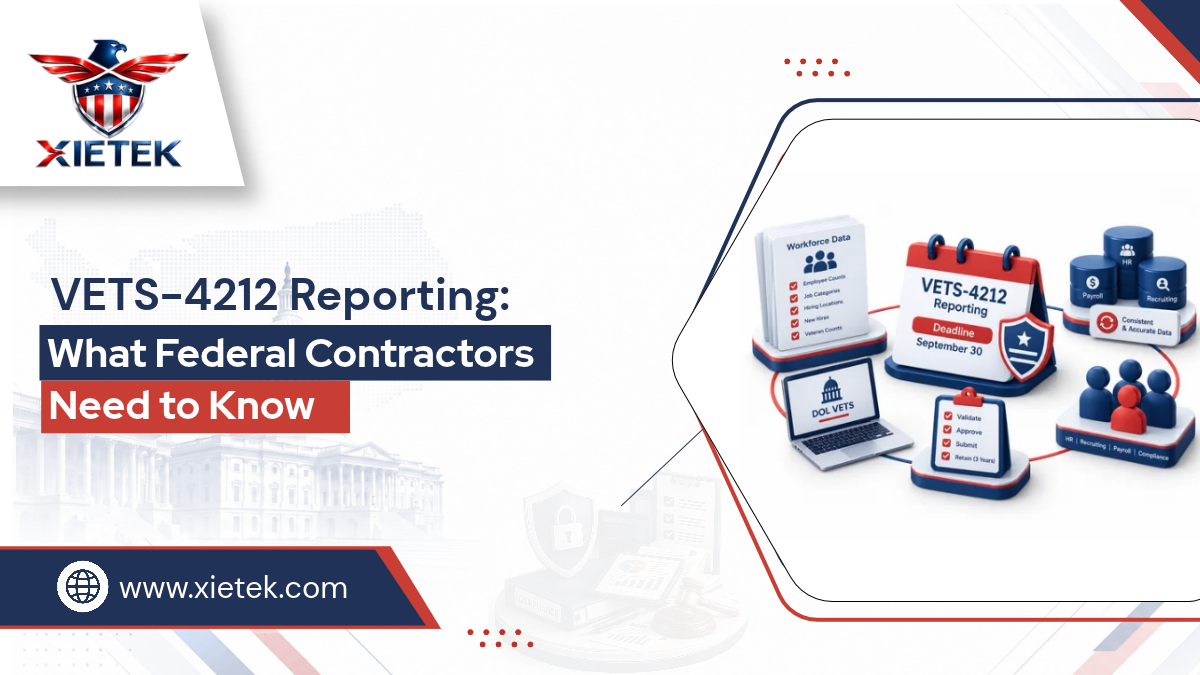
September 30 is the annual deadline for federal contractors and subcontractors required to submit a VETS-4212 report. The U.S. Department of Labor’s Veterans’ Employment and Training Service (DOL VETS) requires covered contractors to report workforce and hiring information related to protected veterans under the Vietnam Era Veterans’ Readjustment Assistance Act (VEVRAA).
For the 2026 filing cycle, reports can be submitted from August 1 through September 30. DOL’s VETS-4212 Federal Contractor Program provides the current filing guidance, reporting resources and submission information contractors need to prepare their reports.
For government contractors, however, VETS-4212 reporting is not simply a September compliance task. It depends on whether HR, payroll, recruiting and workforce records can produce consistent information when the report is prepared.
What Is VETS-4212 Reporting?
VETS-4212 reporting is an annual federal contractor requirement under VEVRAA. DOL explains that covered contractors must report the number of employees in their workforce by job category and hiring location, including the number of qualified protected veterans. Contractors must also report total new hires during the applicable reporting period and the number of those new hires who are qualified protected veterans. The report also captures maximum and minimum employee counts during the reporting period.
DOL’s VETS-4212 form and reporting instructions provide the specific reporting fields and requirements. For contractors, that means the quality of the filing depends heavily on the quality and consistency of the workforce information behind it.
Who Needs to File?
DOL’s current guidance states that nonexempt federal contractors and subcontractors with a contract or subcontract of $200,000 or more are subject to VETS-4212 reporting requirements, subject to applicable requirements and exemptions.
Contractors should confirm their specific reporting obligation rather than relying on previous filing practices or outdated contract thresholds. DOL’s VETS-4212 Report Advisor can help organizations determine whether they are required to submit a report.
This is especially important for organizations managing multiple contracts, subsidiaries, business units or hiring locations. Confirming reporting responsibility early can prevent confusion when the filing window opens.
What Information Does the Report Require?
VETS-4212 reporting relies on several types of workforce information, including employee counts, job categories, hiring locations, protected veteran counts, new hire information and maximum and minimum employee totals.
DOL requires contractors to select a payroll period ending date between July 1 and August 31 of the current year as the reporting-period ending date. That makes payroll information an important reference point when validating the workforce data used for the report. Because information may come from different systems, contractors should establish a clear process for reconciling HR, payroll, recruiting and workforce records before submission.
Why Workforce Data Accuracy Matters
The biggest operational challenge with VETS-4212 reporting is often not completing the form. It is making sure the underlying data is consistent.
HR may use one job classification while recruiting or payroll uses another. Hiring locations may also be recorded differently across systems. Changes in employee roles, locations or employment status can create additional reconciliation issues. A reliable reporting process starts with clear ownership. HR, recruiting, payroll, contracts and compliance teams should know which system provides the authoritative information for each reporting field and who is responsible for reviewing it.
This approach also creates value beyond VETS-4212 reporting. Consistent workforce data can support staffing analysis, hiring forecasts, workforce planning and broader contract operations.
Prepare Before the September Deadline
Although the official filing cycle runs from August 1 through September 30, contractors can reduce the last minute workload by maintaining reporting ready information throughout the year.
Job classifications should be standardized where possible, hiring location records should remain current and new hire information should be reviewed regularly. Organizations should also document who gathers the information, who validates it, who approves the final report and who maintains the completed filing.
This turns VETS-4212 reporting into a repeatable process rather than an annual data reconciliation exercise.
What Happens When Data Does Not Match?
Data discrepancies can slow reporting even when individual employee records are accurate.
For example, an HR system may show one employee count for a location while payroll uses a different location structure. Recruiting records may classify a position differently from the categories used for VETS-4212 reporting. Employees who change positions or locations may also require additional review.
Before submitting the report, contractors should reconcile employee totals with payroll records, verify hiring locations, review job classifications, confirm new hire information and validate the selected reporting period. An internal review provides an opportunity to resolve discrepancies before they become a filing problem.
Filing and Record Retention
DOL encourages contractors to submit VETS-4212 reports electronically through its VETS-4212 Reporting Application. Contractors with more than 10 hiring locations are encouraged to use the batch upload process.
DOL also states that requests for filing extensions are not accepted. Contractors should therefore build sufficient time for data validation and internal review into their compliance calendar rather than treating September 30 as the start of the final review. Completed annual VETS-4212 reports must be retained for three years. Maintaining those records with other federal compliance documentation can also make future reporting cycles easier to manage.
A Practical VETS-4212 Readiness Process
A strong VETS-4212 reporting process starts by confirming the organization’s reporting obligation and identifying the covered contracts and hiring locations within scope.
The next step is to establish the reporting period data and reconcile workforce totals. HR and recruiting records should then be reviewed against payroll information for job classifications, hiring locations, new hires and other relevant workforce data. Finally, a designated reviewer should validate the completed report before submission and confirm that the organization has retained the necessary records.
DOL’s VETS-4212 Federal Contractor Reporting guidance remains the primary source for current filing requirements and reporting resources.
What Federal Contractors Should Do Now
The September 30 deadline is a useful reminder that federal compliance depends on operational data practices throughout the year.
Contractors should review how workforce information moves between HR, payroll, recruiting and compliance teams. They should also identify inconsistent classifications or location records and establish a repeatable process for validating the information used in VETS-4212 reporting. For contractors with multiple locations or changing workforce requirements, improving this process can provide benefits beyond one annual filing. Better workforce data can support more informed staffing decisions and give program leaders greater visibility into the people supporting federal contracts.
Frequently Asked Questions
VETS-4212 reports are due annually by September 30. The official filing cycle runs from August 1 through September 30.
DOL’s current guidance states that nonexempt federal contractors and subcontractors with covered contracts or subcontracts valued at $200,000 or more must file, subject to applicable requirements and exemptions.
The report includes workforce counts by job category and hiring location, qualified protected-veteran counts, new-hire information and maximum and minimum employee counts.
No. DOL states that requests for VETS-4212 filing extensions are not accepted.
Companies must retain copies of completed annual VETS-4212 reports for three years.
Contractors can use DOL’s VETS-4212 Federal Contractor Program and VETS-4212 Reporting Application for current filing information, instructions, FAQs and submission resources.
Strengthen Workforce Data and Reporting Readiness
XieTek LLC provides Staffing Services designed to help government contractors strengthen the workforce processes that support federal contract operations. From recruiting and staffing coordination to workforce data management and hiring analytics, our team helps organizations improve consistency across the recruiting, HR and staffing information they rely on to manage their workforce.
Ready to strengthen the workforce processes behind your federal reporting and staffing requirements? Contact XieTek LLC today to explore Staffing and RPO Services aligned with your contract environment and workforce needs.