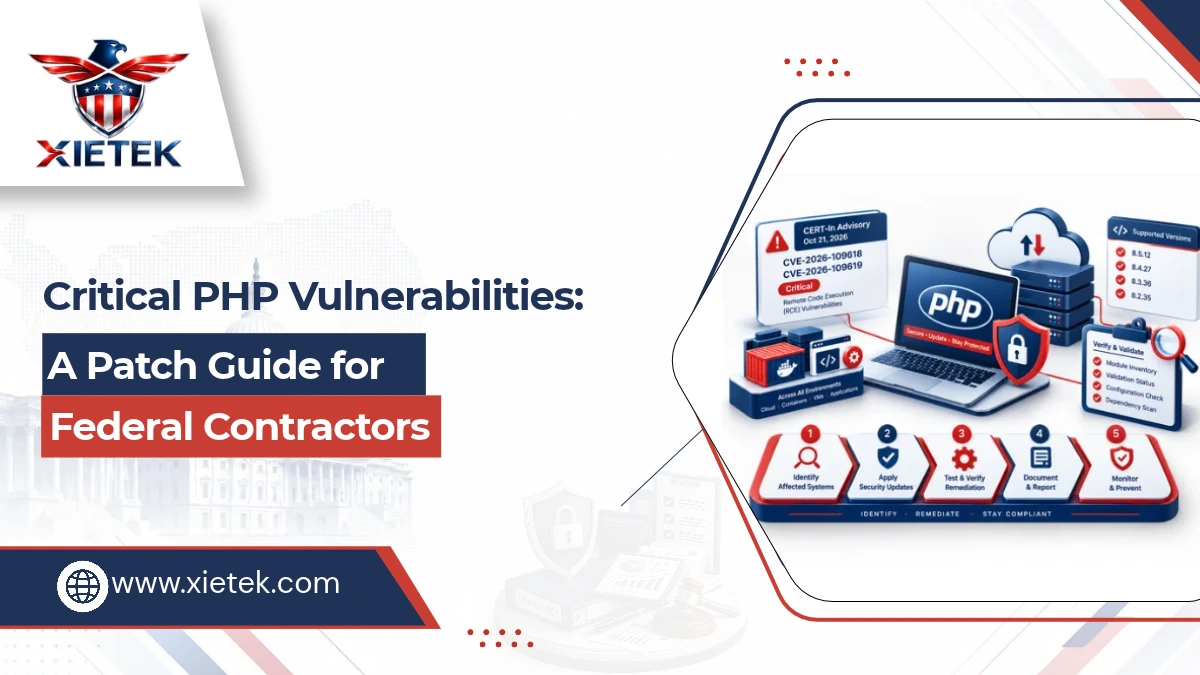
A critical PHP vulnerability can expose web applications to remote code execution, putting sensitive information, connected systems and service continuity at risk.
For federal contractors, the challenge is not just applying a security update, it is identifying every affected runtime and verifying that remediation reaches production systems, container images and externally managed environments. On October 21, 2026, CERT-In issued a critical advisory for two PHP vulnerabilities, CVE-2026-109618 and CVE-2026-109619, reporting exploitation in the wild. The official CERT-In advisory and PHP’s security announcement provide the technical details and recommended updates.
These vulnerabilities highlight a recurring challenge for government contractors: software dependencies can extend across cloud workloads, legacy applications, vendor managed services and automated deployment pipelines. Missing even one affected runtime can leave an organization exposed after its primary systems have been patched. This guide explains how federal contractors can identify affected PHP environments, prioritize security updates, investigate possible compromise and document remediation.
What the Advisories Confirm
CERT-In identifies CVE-2026-109618 and CVE-2026-109619 as critical PHP remote code execution vulnerabilities and reports exploitation in the wild. PHP confirms that the vulnerabilities can allow unauthenticated remote code execution, making timely security updates essential for affected systems.
The fixed release levels are PHP 8.5.12, 8.4.27, 8.3.36, and 8.2.35, respectively. Contractors should verify their installed versions and consult the official CERT-In advisory and PHP security announcements to determine the appropriate update for their environments. Operating system vendors and hosting providers may deliver fixes through packages with different version numbering.
PHP 8.2 also reaches the end of its security support on December 31, 2026, making migration to a supported branch an important planning consideration. Additionally, PHP published Windows package rebuilds for a separate Brotli security vulnerability on October 26. Organizations using official PHP Windows packages should check the PHP 2026 news archive for the relevant updates.
Inventory Every PHP Runtime
Start by identifying where PHP is installed and which applications depend on it. Review web servers, virtual machines, cloud workloads, containers, internal portals, staging systems and development environments. Compare existing asset records with vulnerability scans and configuration data to find systems missing from the inventory.
For each instance, record its PHP version, application owner, hosting environment, internet exposure, business purpose and dependencies. This information allows security teams to distinguish high exposure production systems from isolated test environments and assign remediation priorities accordingly. Include subcontractors and third party hosting providers in the review. Ask each provider to confirm whether its environment is affected, which update it will apply and how it will verify the fix. Outsourced infrastructure can still create operational and security risks for a contractor.
Prevent Vulnerable Versions from Returning
A patch applied to a running server may not be enough if the next deployment reinstalls an outdated runtime. PHP may be packaged inside container images or application platforms, so review Dockerfiles, base images, build configurations, dependency manifests and CI/CD pipelines. Update the relevant build inputs and rebuild affected images before deploying them. Where a vendor maintains the application, request remediation instructions and confirmation of the version being deployed.
Add version checks to build and release workflows where practical. This helps prevent outdated dependencies from re-entering production and makes future vulnerability response more consistent. The objective is not just to fix the current deployment but to ensure that the corrected version remains part of the organization’s standard software delivery process.
Prioritize, Patch and Verify
Prioritize internet facing applications, services that process sensitive information and systems connected to internal networks. Consider the advisory’s severity, exploitation reports, system accessibility and potential operational impact when deciding the order of remediation. Coordinate with application owners to address compatibility concerns and maintenance requirements. Test updates in a representative environment when practical and establish a rollback plan for critical applications. Testing should enable a safe update, not become an indefinite reason to postpone it.
After deployment, verify the version actually running in production. Check package records, service configurations, container images and hosting provider confirmations as appropriate. Rescan affected assets and test essential application functions, authentication, logging and integrations. If a vulnerable version remains, investigate whether another runtime exists, the patch failed or an old image was redeployed. Close remediation tasks only when the fix has been confirmed, not merely when the update has been scheduled or installed on one system.
If Immediate Patching Is Not Possible
Some environments may face temporary delays because of compatibility issues, vendor dependencies or maintenance constraints. Document the reason, assign an accountable owner, establish a target remediation date and obtain the required approval for the exception.
Interim safeguards may include restricting external access, limiting network connectivity, disabling unnecessary functionality or increasing monitoring. These measures can reduce exposure but they are not equivalent to the PHP security update. PHP states that no complete mitigations exist for the two critical vulnerabilities. Reassess exceptions regularly, especially when a vendor releases a compatible update or the system’s exposure changes. Clear ownership and dated remediation records help security teams demonstrate that unresolved risks are being actively managed.
Investigate Possible Compromise
Because exploitation has been reported in the wild, patching should be accompanied by an appropriate review for suspicious activity. Examine web server and application logs, authentication events, unexpected file changes, process activity, outbound connections and alerts from endpoint or network monitoring tools.
Look for unusual requests, unfamiliar processes, unexplained account activity or traffic that differs from the application’s normal behavior. Preserve relevant evidence according to the organization’s incident response procedures. If compromise is suspected, follow the incident response plan. Isolate affected systems when warranted, notify the appropriate security and leadership teams and assess whether credentials, secrets or connected systems may also be at risk. Installing an update does not remove an attacker who may already have established persistence.
Document the Response and Improve Patch Management
Maintain a concise record connecting the advisory to affected assets, remediation decisions and final outcomes. Include scan findings, deployed versions, change tickets, test results, exception approvals and third party confirmations. Assign each remediation task an owner and closure date.
This evidence supports accountability and helps security leaders explain how the organization assessed and addressed the vulnerability. It can also streamline future audits, risk reviews and incident investigations by showing which systems were affected and how remediation was confirmed. Make the process repeatable by defining responsibilities for asset inventory, vulnerability monitoring, patch testing, deployment and verification. Federal contractors should check the security requirements applicable to their contracts and systems rather than assume a single checklist covers every environment.
NIST’s Guide to Enterprise Patch Management Planning offers guidance for establishing a structured patch management program. A consistent process helps organizations respond to urgent vulnerabilities while reducing reliance on ad hoc manual work.
Frequently Asked Questions
The fixed release levels are PHP 8.5.12, 8.4.27, 8.3.36 and 8.2.35 or later within the respective branches. Check the CERT-In advisory and your vendor’s guidance to confirm the correct update for your environment.
They can expose web applications to remote code execution, potentially affecting sensitive information, connected systems and service availability. Contractors should evaluate technical exposure alongside operational impact and applicable contract security requirements.
Combine asset inventories, vulnerability scans, cloud and server records, container image reviews and application owner input. Include development and staging environments, as well as externally hosted services.
Document the delay, assign an owner, establish a deadline and apply suitable interim safeguards. Since PHP states that no complete mitigations exist for these two vulnerabilities, prioritize the permanent update and reassess the risk regularly.
No. Review relevant logs and security alerts, investigate suspicious activity, preserve evidence and follow incident response procedures when warranted. A successful update does not prove that a system has not already been compromised.
Strengthen Your Cybersecurity Posture With XieTek
XieTek LLC provides cybersecurity services to help organizations address security risks, strengthen IT environments, and support mission requirements. A structured approach to security operations, vulnerability management, and risk mitigation can help federal contractors identify potential weaknesses and improve their overall security posture.
Looking to strengthen your organization’s cybersecurity defenses? Contact XieTek LLC to discuss your security priorities, vulnerability management needs, and strategies for protecting your IT infrastructure against evolving cyber threats.