Winning a government contract is only the beginning. The real test starts when it is time to deliver.
A contractor can have a strong proposal, competitive pricing, and a clear technical solution. Without the right people, even a well-planned program can fall behind. Critical positions may remain open, specialized skills may be difficult to find, and hiring delays can put pressure on project timelines. For government contractors, staffing is therefore more than filling vacancies. It is about building a workforce that can meet contract requirements, support mission objectives, and remain ready as program needs change.
The opportunity is significant. The U.S. Small Business Administration reported that small businesses received nearly 28% of federal prime contract awards in fiscal year 2025, representing about $179 billion. Including prime contracts and subcontracts, small businesses received nearly $273 billion in federal contract awards.
Building a Workforce That Supports Contract Performance
As more organizations compete for federal work, having a reliable talent strategy can become an important competitive advantage. A strong workforce plan can help contractors respond to contract demands, manage changing workloads, and maintain delivery standards.
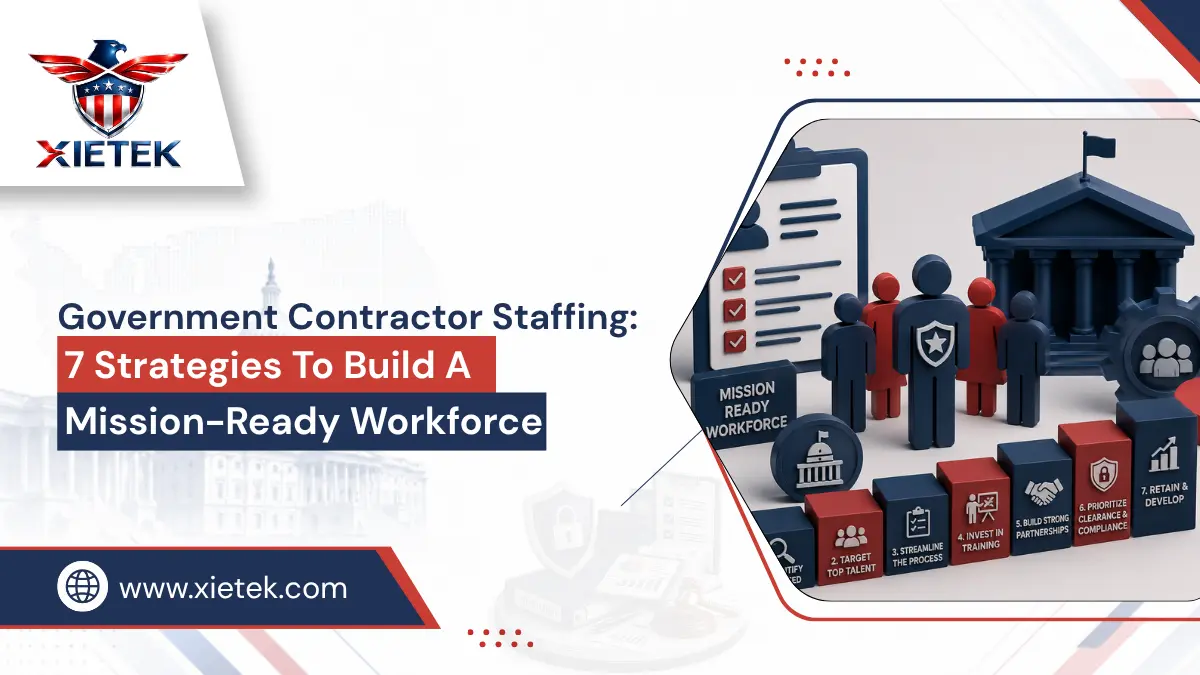
Here are seven strategies to help build a qualified, scalable, and mission-ready workforce.
1. Start With Contract Requirements, Not Just Job Descriptions
Government contractor staffing should begin with the contract. A standard commercial job description may focus mainly on skills, experience and responsibilities. Government contracting often requires a more detailed match between the candidate and the actual contract requirements. Before beginning a search, identify the required labor categories, education and experience requirements, technical qualifications, certifications, security clearance requirements, contract-specific experience, location and work arrangements, start dates, performance expectations and any key personnel requirements. This helps recruiters understand what a successful candidate actually looks like and reduces the risk of presenting candidates who appear qualified on paper but do not meet the requirements of the contract.
The Federal Acquisition Regulation includes provisions that can make specified personnel important to contract performance. For example, applicable contracts may identify key personnel and establish requirements around their replacement. That makes contract-fit screening an important part of federal contractor staffing. The question should not simply be, “Can this person do the job?” It should be, “Does this person meet the requirements for this specific contract and mission?”
2. Build Talent Pipelines Before You Need Them
Waiting until a contract is awarded to start recruiting can create unnecessary pressure. By the time a contractor receives an award, the clock may already be running. Hiring managers may need qualified professionals quickly, while competitors may be targeting the same talent pool. A stronger approach is to build talent pipelines before positions become urgent. This can include developing relationships with experienced technical professionals, IT specialists, engineers, cybersecurity professionals, program managers, cleared candidates, healthcare professionals, administrative specialists and other mission-specific talent. For government contractors, maintaining specialized pipelines can reduce the time required to identify qualified candidates when a new requirement appears. This is particularly important for difficult-to-fill roles and positions requiring security clearances.
A proactive pipeline also supports business development. When a contractor is preparing a proposal, knowing where qualified talent can come from can strengthen its staffing plan and demonstrate delivery readiness.
3. Make Cleared Recruitment a Strategic Capability
Security-cleared talent can be difficult to find, particularly when a program requires specialized technical experience in addition to a specific clearance. Contractors competing for defense, intelligence, cybersecurity and other sensitive programs may need professionals with Secret, Top Secret, TS/SCI, or Public Trust eligibility, depending on the role and contract. Cleared recruitment should therefore be treated as a specialized capability rather than simply another recruiting filter. A strong process can consider current clearance status, clearance requirements for the role, technical qualifications, relevant government or industry experience, availability, location requirements, mission and program fit and verification requirements. The goal is to find candidates who satisfy both the talent requirements and the security requirements.
XieTek’s staffing model specifically focuses on cleared candidate pipelines and includes sourcing for Secret and TS/SCI professionals, along with screening against labor categories and mission requirements. For contractors working in sensitive environments, this type of specialized talent acquisition can help reduce hiring delays and improve workforce readiness.
4. Use Staff Augmentation to Manage Changing Demand
Not every staffing need requires a permanent hire. Government programs can experience temporary surges, new task orders, accelerated timelines, or changing technical requirements. Building a large permanent workforce for every short-term requirement may not be the most practical approach. This is where staff augmentation services can provide flexibility. Staff augmentation allows organizations to add qualified professionals to existing teams for a defined period or project need. It can be useful when a contractor needs to support a temporary workload increase, add specialized technical skills, meet an accelerated deadline, fill a short-term vacancy, expand a project team, support a new contract, or bridge a hiring gap.
Depending on the situation, contractors may use contract staffing, contract-to-hire arrangements, or direct placement. The right model depends on the contract, workforce strategy, timeline and long-term need. For organizations with changing workloads, flexible staffing solutions can make it easier to scale resources without rebuilding the entire workforce each time requirements change.
5. Screen Candidates for Technical and Contract Fit
Finding someone with the right technical background is only one part of the equation. Government contractor staffing requires a closer look at whether a candidate fits the specific role, labor category, program environment and contract requirements.A structured screening process can evaluate technical fit, meaning whether the candidate has the required skills and experience. It should also consider contract fit, including whether the candidate meets the applicable labor category and contract requirements. Mission fit looks at whether the candidate understands the environment and objectives they will support, while security fit considers clearance or access requirements. Cultural fit helps determine whether the candidate can work effectively within the contractor’s team and customer environment. Finally, retention fit considers whether the role and work environment are likely to support long-term performance.
This approach can help reduce costly mismatches. XieTek’s staffing process uses multi-layer vetting and contract-fit screening to evaluate candidates against technical requirements, labor categories, contract stipulations and mission needs. For contractors, the value of this approach goes beyond filling a position. It helps create teams that are better aligned with actual program requirements.
6. Connect Staffing With Pre-Award Strategy
Staffing should not begin after the contract award. It can also play an important role before the award. When responding to an RFP, government contractors may need to demonstrate that they have access to qualified personnel who can perform the work. A strong staffing strategy can support proposal development by helping contractors demonstrate staffing readiness, labor category coverage, candidate availability, technical expertise, clearance availability, recruiting timelines, contingency plans and workforce scalability. Pre-award staffing support can therefore strengthen the connection between business development, proposal development and contract execution.
For example, if a proposal requires several specialized technical roles, having a realistic staffing plan can make the proposed solution more credible. XieTek specifically provides pre-award staffing support, including staffing readiness, contingency planning, cleared talent and alignment with RFP requirements. This creates a more complete approach: identify the opportunity, understand the workforce requirements, prepare the talent strategy and demonstrate the ability to execute.
7. Retain and Support Talent After Placement
Hiring someone is not the final step. High turnover can create disruption, increase recruitment costs and make it harder to maintain continuity on mission-critical programs. For government contractors, employee retention can be especially important when personnel have developed knowledge of a customer’s environment, systems, processes and mission. A strong post-placement strategy can include structured onboarding, readiness checks, regular employee check-ins, performance feedback, early issue identification, career development, recognition and engagement and replacement planning. The first few weeks can be particularly important. Employees should understand their responsibilities, reporting structure, contract environment, security expectations and performance objectives. Ongoing communication can also help identify problems before they result in turnover.
XieTek’s staffing service includes onboarding support, retention check-ins, issue resolution and post-placement monitoring to support longer-term workforce stability. The objective is not simply to make a placement. It is to help the placement succeed.
Measuring the Success of Your Staffing Strategy
A staffing program should be measured by more than the number of positions filled. Useful metrics can include time-to-fill, time-to-start, candidate quality, offer acceptance rate, retention rate, time-to-productivity, contract compliance, hiring manager satisfaction, candidate pipeline size and replacement rate.
For government contractors, it can also be useful to measure how effectively staffing supports contract performance. Staffing teams can track whether required positions were filled on time, whether critical personnel were ready before the performance period began and whether staffing gaps affected delivery.
These measures connect recruitment results to actual business outcomes. They can also help contractors identify areas where their workforce strategy needs improvement.
Building a Mission-Ready Workforce
A mission-ready workforce does not happen by accident. It requires planning before the contract, targeted sourcing during recruitment, structured screening, flexible staffing models and support after placement. The most effective government contractor staffing strategies connect people, contracts and mission requirements. Contractors can build talent pipelines before urgent requirements appear, focus recruitment on skills and contract fit, use flexible staffing models when demand changes, demonstrate staffing readiness during proposals and continue supporting employees after placement.
For contractors, the workforce is not simply an operating expense. It is one of the primary resources responsible for delivering the promises made in a proposal. A thoughtful staffing strategy can help organizations respond faster, reduce hiring gaps and maintain the people needed to support contract performance.
Frequently Asked Questions
Government contractor staffing often requires a closer match between the candidate, contract requirements, labor categories, mission needs and security requirements. Contractors may also need professionals who can meet specific start dates, certifications, experience levels, or clearance requirements.
Building talent pipelines early can help contractors respond faster when a contract is awarded. It gives recruiters access to potential candidates before hiring becomes urgent and can be especially useful for specialized and security-cleared positions.
Cleared recruitment focuses on finding professionals who meet the security requirements of a government contract. Depending on the position, contractors may need candidates with Secret, Top Secret, TS/SCI, or Public Trust eligibility. Cleared recruitment also considers technical skills, experience, availability and mission fit.
Staff augmentation allows contractors to add qualified professionals to an existing team for a specific project, workload increase, short-term vacancy, or contract requirement. It gives organizations more flexibility when workforce needs change without requiring a permanent hire for every position.
Contract-fit screening helps determine whether a candidate meets the actual requirements of a specific contract. This can include labor category qualifications, technical experience, certifications, security requirements, availability and mission needs. It can reduce the risk of hiring or presenting candidates who do not meet contract expectations.
Staffing can support proposals by helping contractors demonstrate that they have access to qualified personnel who can perform the work. A strong staffing plan can address labor category coverage, candidate availability, clearance availability, recruiting timelines and workforce scalability.
Contractors should consider government contracting experience, access to specialized and cleared talent, contract-fit screening, recruiting speed, flexible staffing models, compliance practices and post-placement support. A strong staffing partner should understand the connection between recruitment and contract performance.
Contractors can support retention through structured onboarding, regular employee check-ins, performance feedback, career development, recognition, early issue identification and replacement planning. Continued communication can help identify workforce concerns before they lead to turnover.
Beyond the number of positions filled, contractors can track time-to-fill, time-to-start, candidate quality, offer acceptance, retention, time-to-productivity, contract compliance, hiring manager satisfaction, pipeline size and replacement rates. Connecting these measures to contract performance can provide a clearer view of staffing effectiveness.
Build a Mission-Ready Workforce With XieTek LLC
XieTek LLC provides Staffing Services designed to help government contractors and organizations build qualified, mission-ready teams through flexible workforce solutions.
From cleared candidate sourcing and contract-fit screening to pre-award staffing, contract staffing, contract-to-hire, direct placement, onboarding and post-placement support, our team helps organizations find the talent they need to keep programs moving.
Ready to strengthen your workforce? Contact XieTek LLC today to discuss your staffing requirements and build a talent strategy aligned with your next contract or mission.