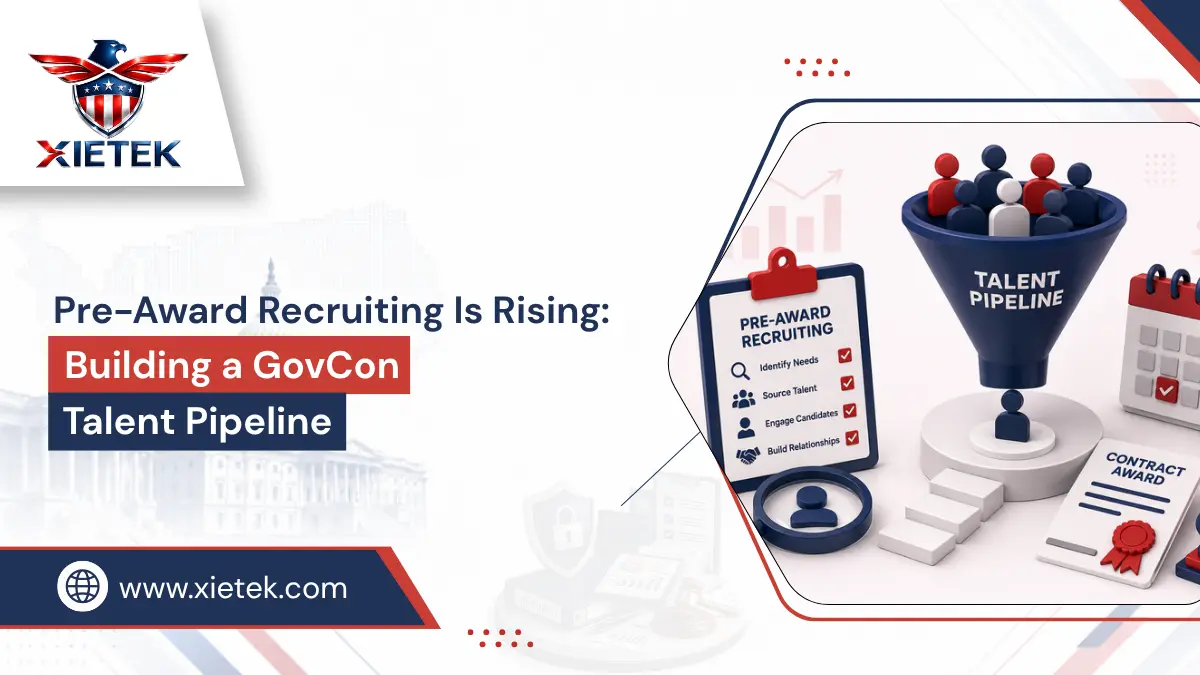
The worst time to discover that your proposed workforce is difficult to hire is after you win the contract.
For government contractors, recruiting can quickly become an execution issue after award. A contract may require specialized skills, key personnel, cleared professionals, or rapid staffing across several locations. If recruiting starts only after award, the transition period can become a race against the performance schedule. There is no federal rule requiring contractors to use “pre-award recruiting.” However, federal acquisition rules make workforce readiness relevant to contractor responsibility.
That creates a practical case for earlier talent planning. Contractors do not need to hire an entire workforce before award. Instead, they can identify staffing risks, test the labor market, build qualified pipelines, and prepare to move when an award arrives.
In this blog, we examine how pre-award recruiting supports GovCon workforce planning, where recruitment process outsourcing fits, and which positions deserve attention before award.
Why Talent Planning Should Start Before Contract Award
A strong technical proposal does not guarantee a smooth transition into performance. The proposed solution still depends on people who can execute it. For labor-heavy contracts, workforce planning can become an important part of capture and proposal preparation. Federal responsibility standards require prospective contractors to demonstrate access to the resources needed for performance. When those resources are not already available, the contracting officer can require acceptable evidence that the contractor can obtain them.
The official FAR 9.104-3 contractor responsibility standards specifically address the ability to obtain required resources. The FAR states that acceptable evidence normally consists of a commitment or explicit arrangement to acquire needed facilities, equipment, resources, or personnel by contract award. This does not mean contractors should make unnecessary employment commitments. It means the capture team should understand whether the proposed workforce can realistically be assembled.
Pre-Award Recruiting Is Not Pre-Award Hiring
Pre-award recruiting means creating hiring readiness before the contract is won. Contractors can identify likely positions, research the labor market, source candidates, conduct initial screening and maintain candidate relationships without placing the entire workforce on payroll. A disciplined approach separates pipeline development from employment commitments. This lets contractors understand talent availability while managing the financial risk of an uncertain award.
Recruitment process outsourcing can support this model by adding sourcing and recruiting capacity during active pursuits. The objective is straightforward: if the government says yes, how prepared is the contractor to turn its staffing plan into an operating workforce?
Start With Contract Requirements, Not Job Descriptions
Recruiting should begin with the opportunity itself. Capture, proposal, program and recruiting teams should identify which labor requirements could affect the pursuit or transition. Review expected labor categories, technical skills, certifications, locations, security requirements and key personnel. Recruiters can then build candidate profiles around the actual contract environment rather than generic job descriptions.
This process also gives proposal teams useful market intelligence. If recruiters discover that a required skill is unusually scarce or expensive, the team can address the issue before finalizing staffing and pricing assumptions. Early market feedback can expose problems that might otherwise appear only after award.
Which Positions Actually Need Pre-Award Recruiting?
Treating every proposed position as equally urgent wastes recruiting resources. A difficult-to-find program manager may create significant contract risk, while a common support position may be sourced quickly after award. Cleared technical roles can introduce another level of difficulty. Contractors should prioritize recruiting using two questions:
How difficult will this role be to fill?
How much contract risk will we face if it remains vacant?
Those questions form the basis of a simple Pre-Award Talent Risk Matrix:
| Lower Contract Impact | Higher Contract Impact | |
|---|---|---|
| Easier to Source | Validate market availability | Pre-screen qualified candidates |
| Harder to Source | Begin targeted sourcing | Build and maintain a deep pipeline |
Easier to source + lower impact: Validate availability, compensation, location and sourcing channels. Intensive pre-award recruiting is usually unnecessary.
Easier to source + higher impact: Identify and pre-screen several qualified candidates. The talent may be available, but vacancies could still disrupt transition.
Harder to source + lower impact: Begin targeted sourcing early and monitor availability. These positions may take time to fill without immediately threatening performance.
Harder to source + higher impact: Build pipeline depth before award. These may include key personnel, niche specialists, cleared professionals, or talent in difficult locations.
Contractors should then apply another filter: security requirements. A seemingly easy position can become difficult when clearance, technical skills, location and compensation requirements overlap. The matrix shifts the question from “How many people do we need?” to “Where could talent availability threaten our ability to perform?”
Cleared Recruitment Requires Earlier Coordination
Cleared recruitment introduces considerations that ordinary commercial hiring does not. DCSA states that federal employees, contractors and military members can be subject to background investigations, with the required investigation depending on the position. The process can involve questionnaires, investigation, eligibility decisions, clearance decisions and continuous vetting.
Government contractors pursuing cleared work should therefore understand the official DCSA investigations and clearance process before building assumptions around cleared talent. Security requirements can affect who qualifies for a position and how workforce planning develops. Recruiting teams should coordinate with the appropriate security, HR and program personnel rather than treating clearance as another field on a job description.
A 2026 DCSA Update Contractors Should Know
Cleared workforce planning continues after hiring. In May 2026, DCSA announced a significant change to the Continuous Vetting process for National Industrial Security Program contractor personnel. Periodic reinvestigations are no longer required for NISP contractor national security personnel. Instead, individuals must submit an updated Personnel Vetting Questionnaire every five years, regardless of eligibility level. DCSA now bases the timing on the PVQ Date recorded in DISS.
Contractors supporting applicable NISP work should review the official DCSA 2026 Continuous Vetting update when planning cleared workforce processes. The change does not create a reason to recruit before award. It reinforces a broader point: cleared workforce management and personnel security are connected. Recruiting teams need to understand available talent, security teams need to manage vetting requirements and program leaders need to understand how both affect workforce readiness.
Where Recruitment Process Outsourcing Fits
A contractor’s internal recruiting team may handle normal hiring demand effectively. Major federal pursuits can create a very different workload. One opportunity might require dozens of candidate pipelines, while several simultaneous bids can multiply that demand. Cleared or niche technical positions add further sourcing complexity.
Recruitment process outsourcing services can provide scalable recruiting capacity during these periods. An RPO recruitment team can support sourcing, screening, pipeline management, recruiting operations and workforce planning while the contractor retains control over hiring decisions. This can be particularly useful for small and mid-sized government contractors that have the technical capability to perform the work but limited internal recruiting bandwidth.
Use Recruiting Data to Test Proposal Assumptions
Pre-award recruiting can produce something as valuable as candidates: labor-market intelligence. Suppose a capture team assumes it can hire a specialized engineer within 30 days. Early sourcing may show that qualified candidates expect higher compensation. Recruiters may discover that cleared candidates are concentrated outside the proposed work location. A required certification could further reduce the available pool.
That information can influence pricing, transition schedules, recruiting budgets, work-location strategies and staffing approaches. This is where RPO for government contractors can provide value beyond candidate sourcing. Recruiting data becomes an input to capture planning rather than an activity that begins after capture ends.
Build a Pipeline That Reflects Reality
A spreadsheet containing hundreds of names does not automatically represent a strong talent pipeline. Contractors should track candidates who actually match the requirements. Useful factors include qualifications, interest, compensation alignment, location, clearance status, availability and likelihood of accepting an offer. High-risk positions also need alternatives because one strong candidate can accept another job while the government evaluates proposals.
Federal timelines can change as well. Contractors should refresh critical pipelines throughout the pursuit by confirming availability and replacing candidates who leave the market. This keeps the pipeline useful instead of allowing it to become a static proposal artifact.
Keep Candidates Engaged Without Overpromising
Candidates should understand when a position depends on contract award and that federal procurement timelines can change. Regular communication can maintain interest without creating false certainty. Contractors should also distinguish between candidate interest and candidate commitment. Someone who responded to a recruiter is not necessarily available for a proposed position.
Proposal and recruiting teams should maintain a shared record of candidate status, especially when a solicitation requests resumes, key personnel, or letters of commitment. The proposal should never communicate more certainty than the recruiting record supports.
When Does RPO Make Sense?
Not every contractor needs recruitment process outsourcing for every pursuit. RPO becomes more useful when expected hiring demand exceeds normal internal capacity. It can also help when a pursuit requires cleared professionals, hard-to-source skills, rapid scaling, multiple locations, or several pipelines at once.
Companies may choose to outsource recruitment services when internal recruiters need to focus on existing contracts. External capacity can support future opportunities without forcing the company to permanently expand its recruiting team. The key question is whether the existing recruitment operation can realistically build and maintain the required talent pipelines before performance begins.
Three Actions Before Your Next Staffing-Heavy Pursuit
First, map the positions that matter most. Use the Talent Risk Matrix to separate routine hiring from roles that could threaten proposal credibility or transition.
Second, test the labor market before locking the staffing plan. Validate compensation, availability, qualifications, location and clearance requirements. Use that information to challenge unrealistic assumptions.
Third, define the recruiting trigger for each position. Some roles may need only market research, while others justify active sourcing, screening, candidate engagement, or deeper pipeline development.
The goal is not to recruit every proposed employee before award. It is to identify where staffing uncertainty could create real performance risk and reduce that uncertainty before it becomes a problem.
From Proposal Promise to Day-One Performance
Pre-award recruiting should not become a race to collect resumes. Its value comes from connecting the proposed workforce with labor-market reality. A stronger approach identifies staffing risk first. Contractors can then test difficult positions, build deeper pipelines where needed, keep candidates engaged and feed recruiting intelligence back into capture planning.
This creates a useful connection between capture, recruiting, security, proposal development and program operations. Recruiting informs staffing assumptions, capture teams understand execution risk earlier and proposal teams can make workforce claims with greater confidence. For government contractors, that is the real value of starting earlier: the workforce plan begins becoming executable before the award notice arrives.
Frequently Asked Questions
Pre-award recruiting means identifying, sourcing and engaging potential candidates before a federal contract award. It helps contractors prepare for staffing demand without necessarily hiring the full proposed workforce.
No. The FAR does not establish a general requirement called pre-award recruiting. However, contractor responsibility standards address required resources and a prospective contractor’s ability to obtain them.
Recruitment process outsourcing is a model where an external provider manages part or all of an organization’s recruiting activities. For government contractors, RPO can add sourcing, screening, pipeline management and recruiting capacity around federal pursuits.
RPO can help contractors test talent availability, build pipelines for high-risk positions and add recruiting capacity when several pursuits create simultaneous workforce requirements.
Cleared recruitment focuses on positions requiring security-cleared or clearance-eligible personnel. Contractors need to consider job qualifications alongside applicable personnel security and vetting requirements.
Not necessarily. Contractors can conduct market research, sourcing, screening and pipeline development without hiring the full workforce. The appropriate approach depends on the opportunity and staffing risk.
Prioritize positions based on sourcing difficulty and contract impact. Hard-to-fill roles that are critical to transition or performance deserve the strongest pre-award pipelines.
Build Your GovCon Talent Pipeline Before the Award
XieTek LLC provides professional Recruitment Process Outsourcing Services designed to help government contractors build scalable, qualified talent pipelines for federal contract opportunities.
From candidate sourcing and screening to pipeline development, recruitment coordination and cleared talent acquisition, our team supports you throughout the recruiting process.
Preparing your workforce for an upcoming federal opportunity? Contact XieTek LLC today to strengthen your recruiting capacity and build a talent pipeline ready to move when the contract does.