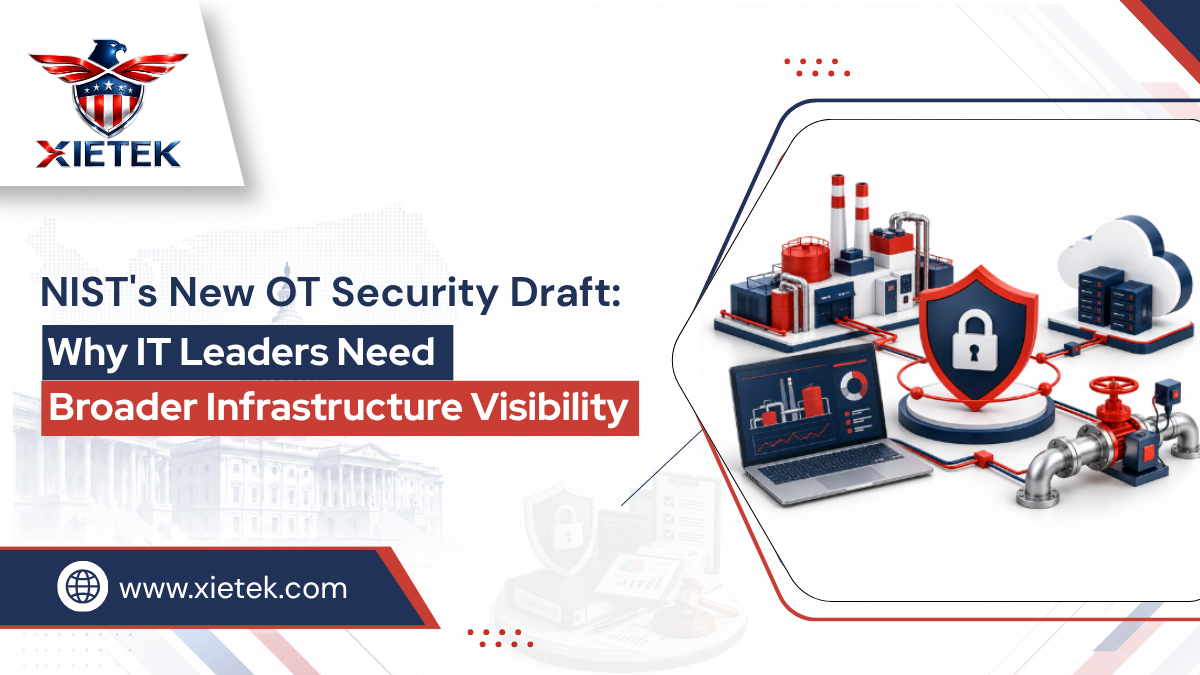
NIST’s latest OT security draft signals a change IT leaders cannot afford to treat as an OT-only issue.
On September 21, 2026, NIST released the initial public draft of SP 800-82 Rev. 4, Guide to Operational Technology (OT) Security. The draft expands coverage to building automation, water and wastewater, freight rail, maritime systems, Industrial Internet of Things and cloud convergence. It also expands guidance on asset management, network monitoring and detection, system management functions and zero trust.
For federal contractors and enterprise organizations, the practical issue is visibility. IT, OT, cloud services, remote access, vendors and connected devices can support the same business or mission outcomes. If these environments are managed as separate islands, security teams may miss how one change affects another. NIST also keeps performance, reliability, availability and safety at the center of OT security.
In this blog, we look at what the draft means for managed IT operations and how IT leaders can turn broader visibility into practical security and operational controls.
Why the IT/OT Boundary Is Getting Harder to Manage
OT is no longer limited to isolated control networks. NIST’s draft addresses IIoT and cloud convergence and describes environments where OT systems connect with enterprise systems, cloud services, edge platforms, vendors and remote users. These connections can improve analytics, maintenance, remote support and efficiency, but they also create more paths that need to be understood and managed.
For contractors operating facilities, laboratories, manufacturing environments, transportation systems, building systems or other technology enabled operations, the question is not simply whether an OT device is secure. IT leaders need to know what it connects to, who can manage it, what business function depends on it and what could happen if it becomes unavailable or compromised. NIST emphasizes that risk assessments should consider logical dependencies and potential physical consequences.
Visibility Should Start With the Asset
A useful asset inventory needs to tell the operations team more than a hostname and IP address. NIST recommends an accurate inventory and says it should support understanding of asset criticality and function. The draft also points to information such as vendor, model, firmware, operating system, software versions, responsible owner and operational criticality.
For managed IT teams, the goal is not to force every OT system into an IT tool. It is to establish a reliable record of what exists, who owns it, how it is configured, what it depends on and how important it is to operations. If an asset cannot be tied to an owner and a business or mission function, its risk is harder to prioritize. Visibility must also survive change. NIST discusses configuration management, maintenance tracking and centralized documentation of changes. Connecting asset records with approved changes, maintenance windows, vendor activity and configuration baselines helps teams distinguish expected activity from drift or unauthorized changes.
Monitor Without Disrupting Operations
Broader visibility does not mean installing aggressive monitoring everywhere. OT systems can have different availability, reliability and safety requirements from traditional IT. NIST notes that some standard IT actions, such as rebooting a component, may not be acceptable in OT because of operational consequences.
Network monitoring is therefore a key part of the updated guidance. NIST recommends continuous observation and analysis of OT traffic to identify anomalous activity and maintain situational awareness. It also highlights the value of understanding normal network behavior, including expected communication pairs, protocols, ports, polling intervals, traffic volumes and command patterns. A reliable baseline helps teams distinguish unusual activity from normal operations.
Monitoring tools should be tested before deployment, tuned with real traffic and reviewed with OT personnel. NIST also warns that automated response actions suitable for IT may disrupt time critical control or safety functions. In some OT environments, alerting and human led response may be safer than automatic blocking close to field devices.
Protect Management and Remote Access Paths
NIST’s revision gives specific attention to system management functions, including configuration, patching, access control and asset management. Operational networks and management networks can have different traffic and availability requirements, so combining them without appropriate controls can introduce risk.
For IT leaders, ask whether administrators, vendors, monitoring platforms and maintenance tools reach OT assets through clearly defined and controlled paths. Segmentation, DMZs, restricted management paths and strong access controls can reduce unnecessary exposure. NIST also connects these practices with zero trust, while recognizing that some OT devices cannot support full zero-trust capabilities. Remote access deserves the same discipline. NIST recommends documenting the business justification for external access, defining security controls and responsibilities, maintaining the ability to revoke access and auditing access activity. Third-party sessions should also be compared with approved work orders and maintenance schedules. A practical managed IT process should give every remote session a clear owner, purpose, scope and end point.
Change Management Needs OT Guardrails
Patch management remains important, but OT environments require more operational judgment. NIST recommends an OT patch process that defines how patches are identified, when they should be applied, how they are tested and what compensating controls can reduce exposure when patching is delayed. The process should account for reliability, availability and safety.
Configuration management follows the same principle. Approved baselines should be documented, changes should be tested and approved and automated tools should be assessed for possible effects on OT operations. A stronger measure of managed IT performance is not simply “every system is patched.” It is whether the organization can explain why a change was made, whether it was tested, who approved it and what risk remains if the change cannot be made immediately.
What IT Leaders Should Review Now
Because SP 800-82 Rev. 4 is an initial public draft, it should be treated as a forward looking guidance signal rather than a new contractual requirement. NIST’s public comment period runs through November 30, 2026. Contractors can still use the draft to identify gaps and prepare for the direction of modern OT security guidance.
Start with five questions:
- Do we have a current inventory of IT, OT, IIoT, cloud-connected and remotely managed assets? Can we identify the owner and operational criticality of important assets?
- Do we have visibility into network and system activity without interfering with operations?
- Are administrative and vendor access paths controlled, monitored and revocable?
- Can we trace important configuration and patch changes to an approved process and maintenance window?
If an answer is unclear, do not automatically start by buying another security tool. First identify the visibility gap, the operational consequence and the owner responsible for closing it. Managed IT should connect asset management, monitoring, configuration control, access management and incident response into one coordinated operating process.
The Bigger Managed IT Takeaway
SP 800-82 Rev. 4 reflects a broader reality. Infrastructure security is becoming harder to separate into IT, OT, cloud and vendor categories. The more connected these environments become, the more important it is to understand the relationships between them.
For IT leaders, broader visibility supports more than cybersecurity. It supports operational continuity, safer change management, better incident decisions and clearer accountability. The strongest managed IT approach is not the one that monitors the most systems. It is the one that gives decision makers enough context to protect critical infrastructure without disrupting the operations those systems support.
NIST’s broader OT Security program continues to frame cybersecurity risk management as important to the safe and reliable delivery of goods and services supported by OT.
Frequently Asked Questions
NIST SP 800-82 Rev. 4 is an initial public draft that provides guidance for securing operational technology while addressing OT’s performance, reliability, availability and safety requirements. It expands coverage of asset management, monitoring, cloud convergence, system management and zero-trust principles.
IT leaders should care because OT increasingly connects with enterprise IT, cloud services, IIoT platforms, remote users and vendors. These connections create shared dependencies and new attack paths, making infrastructure visibility important for security and operational continuity.
An OT asset inventory should identify the asset, owner, function, operational criticality and relevant technical details such as vendor, model, firmware, operating system and software versions. It should also support change and configuration tracking.
Organizations should use monitoring that fits the operational environment. NIST recommends network and system monitoring, baselining normal activity, testing sensors before deployment and involving OT personnel when interpreting alerts. Automated response should be used carefully because some actions can disrupt OT operations.
No. The September 2026 document is an initial public draft, not a final mandatory requirement. Contractors can use it as forward looking guidance to assess their environments, improve managed IT practices and prepare for evolving OT security expectations.
Strengthen Managed IT Visibility
XieTek LLC provides Managed IT Services designed to help organizations improve infrastructure visibility, security focused monitoring, configuration management and ongoing IT support.
From connected infrastructure monitoring and access management to proactive maintenance and security coordination, our team helps organizations manage complex environments with greater visibility and control.
Ready to strengthen your infrastructure visibility? Contact XieTek LLC to discuss your Managed IT needs.