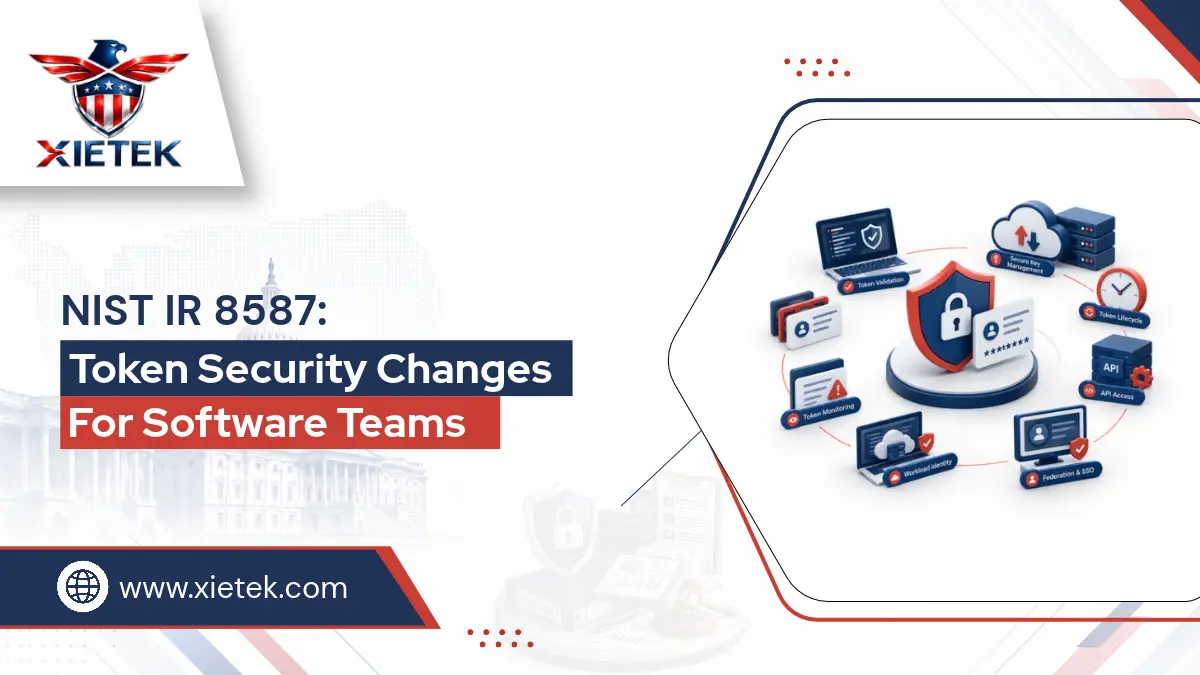
A stolen token can give an attacker access that an application has already approved.
On September 15, 2026, NIST finalized IR 8587, Protecting Tokens and Assertions from Forgery, Theft, and Misuse: Implementation Recommendations for Agencies and Cloud Service Providers. The report provides implementation guidance for federal agencies and cloud service providers on protecting identity tokens, access tokens and assertions from forgery, theft and misuse.
For software teams supporting federal programs, the guidance goes beyond identity provider configuration. It addresses token verification, key management, lifecycle controls, single sign-on, federation, API access and workload identity scenarios. Weak controls in these areas can create unauthorized access, complicate incident response and disrupt applications or services.
In this blog, we look at what NIST IR 8587 means for software teams and how to turn its recommendations into practical development, security and testing checks.
Treat the Token as a Security Boundary
A token helps an application decide whether to grant access. If the application accepts a forged, expired or incorrectly issued token, other security controls may not prevent unauthorized access.
NIST recommends improvements to token verification and lifecycle controls. Therefore, software teams should treat token validation as a security boundary rather than a routine authentication step. Define the expected issuer, audience, signature, validity period and required claims. Then turn those expectations into documented acceptance criteria.
Make Token Validation Explicit
A token can have the correct structure and still be unsafe to accept. For example, an application may receive a correctly formatted token with the wrong audience or an invalid signature.
As a result, teams should document which properties the application must validate before granting access. Automated tests should cover valid tokens, expired tokens, invalid signatures, incorrect audiences and missing required claims. These tests also help prevent different applications or APIs from applying inconsistent validation rules.
The final guidance also emphasizes secure-by-design practices, configurability, interoperability and continuous monitoring. Teams can use these principles when reviewing how token validation works across applications and services.
Reduce the Time a Stolen Token Can Work
Token lifetime directly affects how long a stolen credential can remain useful. A long lived token can give an attacker more time to access a system after compromise.
NIST’s final guidance adds workload identity considerations and reinforces short lived tokens instead of relying on static credentials and secrets in applicable scenarios. It also emphasizes automated key management and rotation.
However, software teams should not simply choose the shortest possible lifetime. They should consider application sensitivity, refresh mechanisms, service availability and operational requirements. The goal is to limit exposure without creating unnecessary authentication failures.
Protect the Keys Behind the Tokens
Token security also depends on the keys used to sign and verify tokens. If an attacker obtains a signing key, the attacker may be able to create tokens that an application considers trustworthy.
The final NIST report provides more flexibility and clarity around signing key protection and usage. It also shifts its approach to signing key validity periods toward system classification and transaction sensitivity while continuing to emphasize automated management and rotation.
Therefore, software teams should review where signing keys reside, who can access them, how applications use them and how the organization rotates and retires them. These controls should also receive operational testing, not just documentation reviews.
Keep Tokens Out of Logs and Build Artifacts
A valid token can function like a credential. Consequently, exposing one through application logs, debugging output or deployment artifacts can create a security problem even when the authentication system itself works correctly.
Review logging around authentication failures, API errors and debugging workflows. Then extend that review to source repositories, test fixtures, CI/CD pipelines and deployment packages. Teams should confirm that sensitive token material does not appear where developers, automation tools or other users could access it unnecessarily.
Design Revocation as a Real Test
Expiration and revocation solve different problems. An expired token reaches the end of its permitted lifetime, while revocation can address a token or credential that should no longer work before its normal expiration.
The final report includes additional options for token revocation and sharing signals. Software teams should therefore define what happens after suspected token theft, credential compromise or another security event.
More importantly, test that response. A revocation design that exists only in documentation does not demonstrate that the application will actually block access when needed.
Build Authentication Tests Into Release Readiness
Token security should form part of normal application and API testing. Teams can turn the requirements into repeatable release checks:
| Test condition | Expected result |
|---|---|
| Valid token | Accepted when required claims and cryptographic properties are valid |
| Expired token | Rejected |
| Invalid signature | Rejected |
| Incorrect audience | Rejected |
| Missing required claim | Rejected |
| Revoked credential | Blocked according to the application’s design |
| Rotated signing key | Approved tokens continue to work during the defined transition |
| Token in error or debug path | Sensitive token material is not exposed |
These checks can support unit, integration, security and release testing. They also create evidence that authentication controls work as designed rather than simply documenting their intended behavior.
Review the Full Token Lifecycle
Token security does not start when an application validates a token. It spans the full lifecycle:
Issue → Transmit → Validate → Use → Refresh → Rotate → Revoke → Expire
For each stage, identify the responsible system or team, the security control and the expected behavior when something goes wrong.
This approach becomes particularly important for APIs, federated applications and workload identities. IR 8587 specifically addresses SSO, federation, API access and workload access scenarios, giving teams a useful reference when mapping tokens across systems and trust boundaries.
Why This Matters Beyond Security Testing
A compromised token can create more than a security incident. It can also trigger emergency credential replacement, service disruption, investigation costs and additional validation work.
For contractors supporting federal programs, authentication weaknesses can affect applications, APIs, cloud services and systems used to deliver contract requirements. Therefore, token management should connect security engineering with application reliability and operational continuity.
This is also why implementation matters. A policy can require secure authentication, but the application still needs consistent validation, protected keys, controlled lifetimes and tested failure behavior.
What Software Teams Should Review Now
Teams do not necessarily need to redesign their authentication architecture immediately. Instead, start with a focused review of the controls already in place.
1. Validation
Identify which token claims and cryptographic properties each application validates. Confirm that invalid conditions produce consistent rejection behavior.
2. Lifetime
Document token lifetimes and compare them with system sensitivity, refresh requirements and workload use cases.
3. Key management
Review key storage, access, usage, rotation and retirement. Identify where automation can reduce manual handling.
4. Exposure
Search logs, repositories, CI/CD systems, test data and deployment processes for accidental token exposure.
5. Testing
Confirm that authentication tests cover expiration, invalid signatures, incorrect audiences, missing claims, revocation and key rotation.
6. Operational response
Document what happens when a token or signing key becomes compromised. Then test the response under realistic conditions.
This review gives software and security teams a practical starting point for applying NIST IR 8587 without treating the report as a reason for an immediate technology replacement.
Frequently Asked Questions
NIST IR 8587 is a NIST report that provides implementation recommendations for protecting identity tokens, access tokens and assertions from forgery, theft and misuse. It focuses on federal agencies and cloud service providers while providing guidance that can also help other organizations using token based authentication.
Developers should validate the properties required by the application’s security design, including the token’s issuer, audience, signature, validity period and required claims. They should also test how the application handles invalid or unexpected values.
Short lived tokens reduce the period during which a stolen token can remain useful. NIST’s final IR 8587 specifically adds workload considerations and reinforces short lived tokens rather than relying on static credentials and secrets in applicable scenarios
Generally, applications should avoid exposing sensitive token material in logs. Teams should review authentication errors, debugging output and other logging paths to ensure tokens cannot be unnecessarily accessed or reused.
QA teams should include authentication and token scenarios in repeatable test cases. These can cover valid and expired tokens, invalid signatures, incorrect audiences, missing claims, revocation, key rotation and accidental token exposure.
Build More Secure Authentication Into Your Software
XieTek LLC provides Web & Software Development Services designed to help organizations build secure, maintainable and scalable software for demanding environments.
From authentication design and API development to security focused implementation reviews and testing, our team helps organizations address security requirements throughout the development process.
Need to review token validation, authentication testing or API security in an existing application? Contact XieTek LLC to discuss your Web & Software Development needs.