Building an impressive AI prototype is becoming easier. Proving that the same system can perform reliably inside a real federal mission environment is much harder. That distinction matters for federal AI software development.
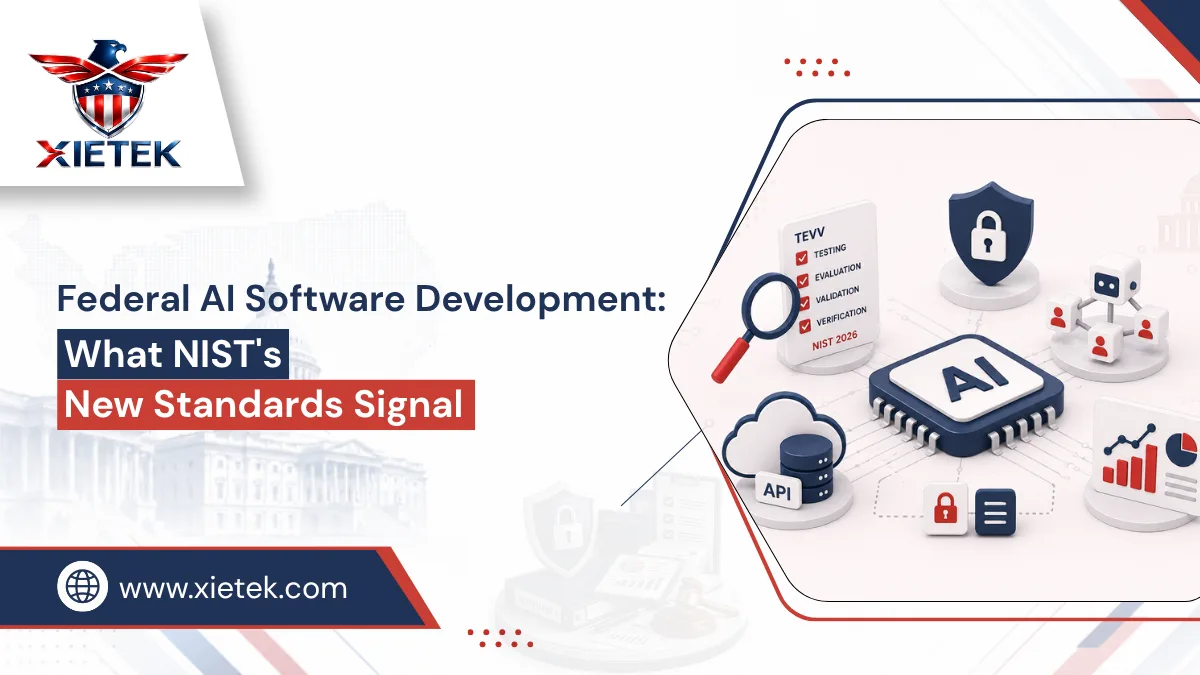
NIST’s AI work in 2026 has placed fresh attention on AI evaluation, agent interoperability, security and testing. In February, NIST launched its AI Agent Standards Initiative, while its broader work on Test, Evaluation, Validation and Verification, or TEVV, continues to examine how organizations can evaluate AI performance.
For government contractors, this does not create a new universal AI compliance requirement. The more useful signal is that AI capability alone may not demonstrate whether a solution is ready for real-world use. Contractors should increasingly be prepared to answer a harder question: How do you know the system will perform as intended?
The AI Demo Is No Longer the Hard Part
Generative AI has lowered the barrier to building prototypes. Teams can connect models to applications, data, APIs and workflows faster than before. But a successful demonstration only proves that a system worked under certain conditions. It does not show how the application performs when inputs change, integrations fail, or the model encounters unfamiliar information.
That gap matters in federal environments. Contractors may need to explain what an AI application should do, how its performance is measured, where its limits are and what happens when results become unreliable. NIST’s work on AI Test, Evaluation, Validation and Verification reflects this challenge.
For development teams, the key lesson is simple: evaluation should influence development rather than become a final checkpoint.
What Changed at NIST in 2026?
On February 17, NIST announced its AI Agent Standards Initiative. The initiative aims to support secure and interoperable AI agents while advancing standards, protocols, identity, security and related research. NIST also expanded work around AI measurement and evaluation during 2026. Its AI program continues to address testing, standards, risk-informed decision-making and research into AI system behavior.
These efforts do not prescribe one development method for every contractor. They do highlight important technical questions:
Can an AI system be evaluated consistently?
Does it meet its intended objectives?
Can AI agents interact securely with other systems?
From “It Works” to “Prove It Works”
Traditional software testing often starts with defined requirements. AI introduces more variability because outputs can depend on prompts, models, data, context and user behavior. An AI development team should therefore define success before testing it. If an application summarizes technical documents, what level of accuracy is acceptable? If it classifies information, how will incorrect classifications be measured? If an AI assistant retrieves information, what happens when the source does not contain the answer?
The answers vary by application, but the development principle remains the same: testing should reflect the intended use of the system. This is where strong custom software development matters. Developers need to connect AI evaluation with application requirements instead of treating the model as an isolated component.
AI Agents Change What Developers Have to Test
AI agents introduce another layer of complexity because they can interact with tools, access information, call APIs, trigger workflows, or take actions across connected systems. Developers may need to evaluate more than output quality. Did the agent select the correct tool? Did it have the appropriate permission? What happened when an external service failed? Could it perform an action outside its intended scope?
NIST’s AI Agent Standards Initiative places interoperability and security within this discussion. For contractors, that makes identity, permissions, integrations, logging and failure handling part of AI quality. A capable model cannot compensate for weak application architecture around it.
The Model Is Only One Part of the Solution
AI discussions often focus on which model performs best. Yet a deployable application includes much more. A federal AI solution may include interfaces, APIs, databases, authentication, cloud infrastructure, data pipelines, logging, monitoring and external integrations. Each component introduces dependencies and potential failure points.
This matters for application development services because teams cannot evaluate the model and assume the complete application is reliable. An AI system may perform well but still fail users if authentication breaks, retrieval produces the wrong records, permissions expose restricted information, or an API becomes unavailable. Federal AI development therefore requires software engineering discipline around the AI itself.
Testing Should Follow the Development Lifecycle
AI evaluation can begin before developers write the first production feature.
Before development, define the mission problem, intended users, expected outputs and acceptable performance.
During development, test realistic scenarios, edge cases, integration failures and situations where the AI should escalate instead of acting.
Before deployment, evaluate the complete application, including models, permissions, APIs, data flows and error handling.
After deployment, continue monitoring because models, data, integrations and user behavior can change.
This makes evaluation part of software design and development, not an exercise added at the end.
Interoperability Creates Value and Risk
AI agents become more useful when they can interact with databases, enterprise applications, cloud services, APIs and other tools. That connectivity can also increase the impact of mistakes. Teams should know what each agent can access, how it authenticates and which actions it can perform. Authorization should limit access to what the task requires, while integrations should fail safely when external services become unavailable.
For enterprise software development, the objective should not be maximum connectivity. It should be controlled interoperability that supports the mission without creating unnecessary authority or dependencies.
Evidence Can Strengthen the Technical Story
Government contractors often differentiate AI solutions through features, automation, models, or new capabilities. NIST’s direction suggests another dimension: evidence. A contractor that can explain how an AI solution was tested, under what conditions, where its limitations exist and how performance will be monitored can present a stronger technical story.
This does not guarantee an acquisition advantage and NIST’s work should not be interpreted as a source-selection rule. But evaluation can improve the solution itself. Testing can reveal where teams need to adjust the model, data, workflow, or application architecture before deployment.
What Should Development Teams Do Now?
Contractors do not need to redesign every AI project while standards continue to evolve. Start with systems already under development. Define intended use, measurable performance, likely failure conditions and known limitations. Then determine whether teams can reproduce evaluation results and explain why the application is suitable for its intended environment.
Look beyond the model as well. Can developers trace failures? Are agent permissions appropriate? Are critical integrations monitored? Is there a fallback when AI cannot complete a task reliably?
NIST’s broader Artificial Intelligence Program provides a useful reference as federal AI measurement, evaluation, standards and research continue to develop. The objective is not to predict every future rule. It is to build AI software that can withstand deeper questions about reliability.
Build for the Mission, Test for Reality
Federal AI is entering a stage where technical capability and technical credibility need to develop together. NIST’s work around TEVV and AI agents reinforces that direction.
For federal AI software development, testing should not begin after the interesting engineering work ends. Testing is part of the engineering work. Contractors that define intended use early, test realistic conditions, design secure integrations and monitor systems after deployment can build stronger AI applications.
The key question is no longer simply, “What can our AI do?” It is also: “What evidence do we have that it can do it reliably when the mission depends on it?”
Frequently Asked Questions
Not by itself. NIST’s initiatives focus on standards, research, interoperability, measurement, and evaluation. Contractors should still follow each solicitation and contract.
Teams should test integrations, permissions, failure handling, data flows, security controls, and application behavior under realistic conditions.
TEVV can help identify weaknesses, measure performance against defined objectives, and assess whether an AI system is suitable for its intended use.
Agents can interact with external systems and take actions. This makes identity, authorization, interoperability, logging, and safe failure behavior more important.
Define intended use, measurable outcomes, realistic tests, known limitations, and post-deployment monitoring now rather than waiting for future standards.
Build AI Solutions for More Than the Demo
XieTek LLC provides professional Web & Software Development Services for organizations that need secure, scalable and purpose-built digital solutions.
From custom software and application development to integrations, testing, modernization and deployment, our team helps turn technology requirements into reliable software.
Planning a custom application or AI-enabled solution? Contact XieTek LLC today to discuss a development approach built around your operational and business requirements.