Winning a federal contract is only the beginning. The real challenge starts when qualified people need to be ready to perform.
For federal contractors, staffing can involve more than matching resumes to job descriptions. A position may require specialized technical skills, certifications, federal experience or eligibility to access sensitive information. As a result, workforce readiness can directly affect how quickly a contractor can begin performing. The Defense Counterintelligence and Security Agency (DCSA) currently supports more than 100 federal entities, 10,000 cleared companies and 2 million background investigations each year.
That scale highlights an important issue for contractors: staffing for federal contracts requires planning beyond the hiring process. Instead of waiting for a critical vacancy, contractors can build targeted talent pipelines around recurring contract requirements. This approach helps recruiting, program and security teams prepare for workforce needs before they become urgent.
Why Cleared Staffing Requires More Than a Resume Search
Traditional recruiting often starts with an open position. However, federal contractor staffing may require several factors to align at once. A candidate may need the right technical background, relevant experience, required credentials, location, availability and appropriate eligibility or access.
Consider a cybersecurity position supporting a federal program. One candidate may have extensive cybersecurity experience but lack the required eligibility. Another may have the appropriate eligibility but lack experience with the required environment. Both candidates may look strong during an initial search. Yet only one may fit the complete requirement. Therefore, federal contractor staffing should evaluate the entire workforce requirement rather than technical qualifications alone.
The process should answer five basic questions:
- Can the candidate perform the required work?
- Does the candidate meet the experience requirements?
- Does the candidate have required credentials?
- Does the position require specific eligibility or access?
- Can the candidate become available within the required timeframe?
This broader view gives contractors a more realistic picture of workforce readiness.
What DCSA’s Clearance Process Means for Contractors
DCSA explains that personnel vetting can involve several stages, including completing a questionnaire, submitting the investigation, conducting the investigation, making an eligibility decision, making a clearance decision and continuing evaluation or vetting. The sponsoring agency determines the appropriate level of investigation based on the position and the potential risk associated with the work. Importantly, not every federal position follows the same investigation or access requirements.
For contractors, this distinction matters. A candidate’s professional experience does not automatically determine whether that person can access classified information or perform a specific position. The government determines eligibility and access through the applicable process. Moreover, DCSA notes that sponsoring agencies can grant interim eligibility or access at their discretion when specific portions of an investigation produce favorable results. Contractors should therefore avoid building staffing plans around assumptions about clearance timing. Instead, recruiting teams should understand the requirements attached to each position and track candidate readiness appropriately.
Interim Eligibility Can Affect Staffing Plans
Interim eligibility can create another layer of consideration for contractors filling sensitive positions. According to DCSA, interim eligibility may be issued when the facts and circumstances support access to classified information. It generally remains in effect while the investigation continues and until a final eligibility determination occurs.
However, contractors cannot guarantee that a candidate will receive interim eligibility. That means staffing teams should distinguish between technical qualification, eligibility, access and actual availability. For example, a candidate could have the required technical background but still need additional government processing before performing duties that require access. Consequently, a strong workforce plan should identify potential gaps before the start date becomes critical.
Build a Talent Pipeline Around Contract Requirements
The most effective Staffing Solutions start with the work itself. Rather than maintaining one general database of candidates, contractors can organize talent pipelines around the capabilities they regularly need.
A federal technology contractor, for example, may repeatedly require:
- Cloud engineers
- Software developers
- Cybersecurity specialists
- Data engineers
- Systems administrators
- Network engineers
- Technical project managers
- Help desk professionals
Each role can have different hiring challenges. A cloud engineer with federal experience may fit one contract but not another if the second program requires a different technology environment or specific access. For that reason, contractors should track more than job titles. Useful pipeline information can include technical specialization, certifications, federal experience, relevant contract experience, location, availability and applicable eligibility information. The objective is not to maintain the largest candidate pool. It is to maintain the most relevant one.
Make Federal IT Staffing More Targeted
Technology requirements continue to create specialized workforce needs across federal programs. Federal IT Staffing may involve professionals working in cloud infrastructure, cybersecurity, software development, data systems, networks, enterprise applications and other technical areas. However, technical expertise alone may not satisfy the full requirement.
A contractor may also need someone with:
- Experience in comparable environments
- Federal or defense experience
- Required certifications
- Specific education or experience
- Availability within the contract schedule
- Appropriate eligibility or access
Therefore, recruiters should translate each contract requirement into clear screening criteria before beginning a search. This approach can reduce wasted recruiting effort. It also gives program managers a clearer view of potential workforce risks.
Turn Contract Requirements Into Recruiting Criteria
One practical way to improve workforce readiness is to create a staffing checklist for every critical position.
1. Technical capability: What skills must the candidate demonstrate?
2. Experience: What type and amount of experience does the requirement specify?
3. Credentials: Does the position require certifications, education, or specialized training?
4. Security: Does the position involve an investigation, eligibility, clearance or specific access?
5. Timing: When must the individual become available?
Recruiters, program managers and security personnel can then work from the same requirements.
As a result, recruiting teams can focus their searches on candidates who are more likely to satisfy the actual contract need.
When Staff Augmentation Makes Sense
Permanent hiring is not always the best answer. Some federal programs experience temporary workload increases. Others need specialized expertise during a particular project phase. In these situations, Staff Augmentation Services can give contractors additional workforce flexibility. For example, a contractor may need software developers during an implementation phase or cybersecurity specialists during a major security initiative. Staff augmentation can expand an existing team without creating the same long-term workforce commitment as permanent hiring.
The appropriate model depends on the requirement:
- Permanent hiring can support long-term workforce needs.
- Contract staffing can address defined personnel requirements.
- Staff augmentation can help teams respond to changing workloads.
Therefore, contractors should match the staffing model to the contract rather than relying on one hiring approach.
A Practical Federal Contractor Staffing Model
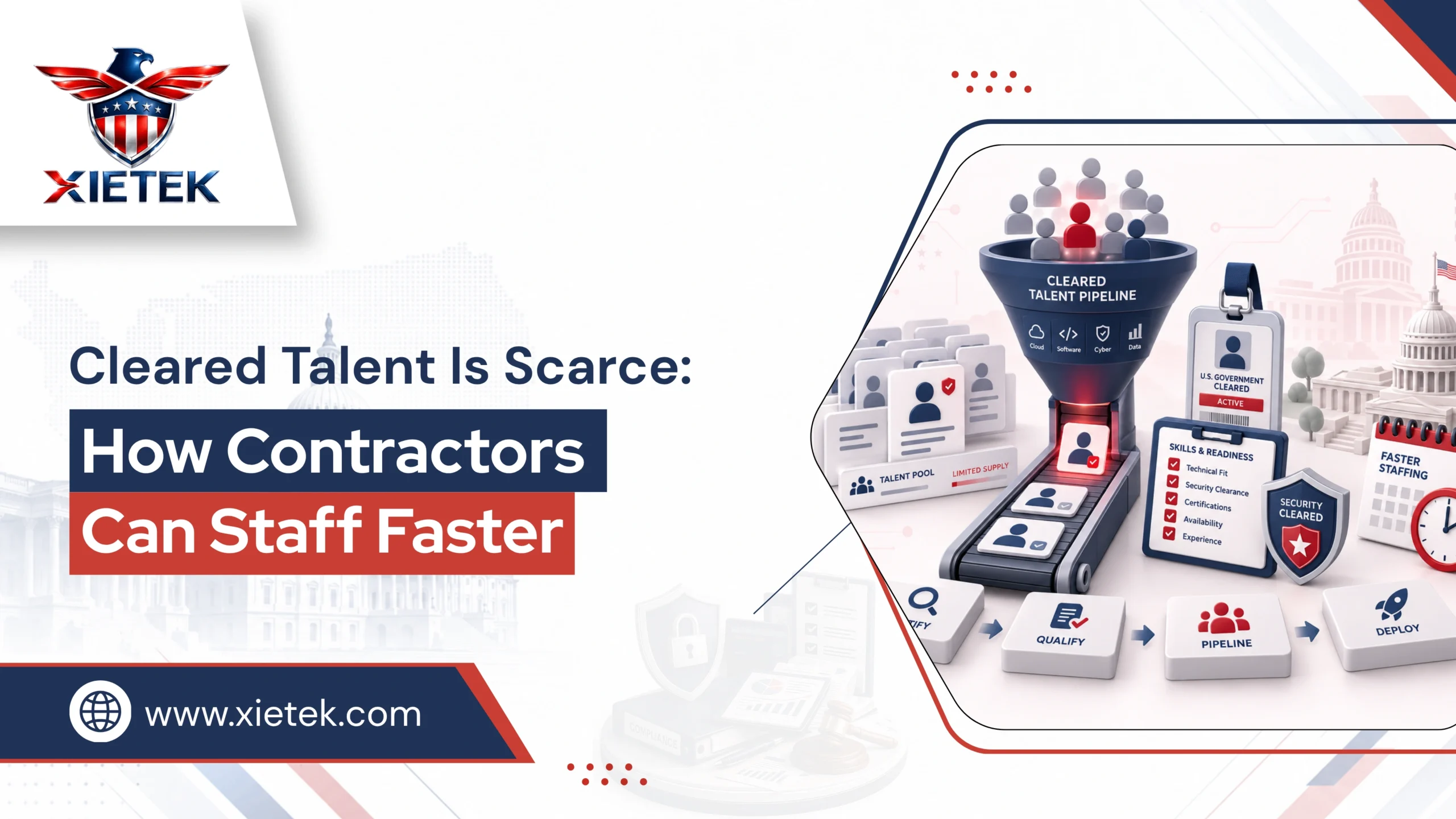
Contractors can simplify workforce planning by using four stages:
1. Identify
Start by identifying positions that support current and anticipated contracts. Prioritize specialized roles that consistently create hiring challenges.
2. Qualify
Define the technical, experience, credential, location and security-related requirements for each position.
3. Pipeline
Build relationships with candidates who meet those requirements. Keep candidate information current so recruiters understand who may be available when demand increases.
4. Deploy
When a requirement becomes active, move qualified candidates through the applicable hiring, onboarding and government-required processes.
This model turns staffing into an ongoing workforce activity rather than a last-minute recruiting exercise.
How Contractors Can Reduce Staffing Delays
A structured staffing process cannot guarantee immediate placement. It can, however, reduce avoidable delays.
Contractors can improve workforce readiness by:
- Identifying difficult-to-fill roles early
- Building relationships with specialized professionals
- Tracking recurring technical requirements
- Separating technical qualifications from security status
- Maintaining current candidate information
- Preparing backup candidates for critical positions
- Reviewing workforce needs as contracts evolve
- Using staff augmentation when demand changes
In practice, these steps give contractors more options when hiring demand rises.They also make workforce gaps easier to identify before those gaps affect contract performance.
Why Workforce Planning Goes Beyond Recruiting
Staffing does not belong to recruiting alone. Program managers understand upcoming workload. Business development teams understand potential opportunities. Recruiters understand the talent market. Security personnel understand applicable personnel security processes.
When these groups share information, contractors can make better workforce decisions. DCSA’s current scale reinforces why this coordination matters. The agency reports that it supports more than 10,000 cleared companies and processes more than 2 million background investigations annually. Furthermore, DCSA’s current billing resources show that its personnel vetting environment includes multiple investigation tiers and continuous vetting services. For contractors, the takeaway is straightforward: workforce readiness deserves attention before a critical position becomes an emergency.
What Federal Contractors Should Do Now
Contractors do not need to wait for a staffing shortage to reveal a workforce gap. Start with the positions that repeatedly create hiring challenges. Next, define the qualifications that truly matter. Then, identify professionals who could meet those requirements and maintain an active pipeline.
At the same time, track availability and relevant eligibility information appropriately. Finally, create a process for moving qualified candidates into open positions when contract demand increases. This approach is more useful than simply saying, “recruit early.” The real objective is to know which people you may need, what they need to qualify and how quickly they could become part of the workforce.
Build a Workforce Ready for Federal Contracts
Cleared staffing will remain an important consideration for contractors supporting sensitive federal programs. Yet the broader lesson extends beyond security clearances. Federal contractors need people who are qualified, available and aligned with the actual work. That makes effective Staffing Services a workforce-readiness function, not simply a recruiting function.
Contractors that understand recurring labor needs, maintain targeted talent pipelines and choose the right staffing model can respond more effectively when contract requirements change. The goal is not to hire everyone before an opportunity exists. The goal is to build enough workforce visibility and talent access so critical positions do not become last-minute obstacles to contract performance.
Staffing services help organizations identify, recruit, screen and place qualified professionals based on specific workforce requirements. For federal contractors, this can include technical staffing, contract staffing, talent acquisition and workforce augmentation.
Federal contractor staffing focuses on finding professionals who can perform work under federal contracts. Requirements can include technical experience, certifications, location, availability and applicable security or access considerations.
Federal IT staffing focuses on recruiting technology professionals for government contracting requirements. Common roles include software developers, cloud engineers, cybersecurity specialists, data professionals and systems administrators.
Yes. Staffing services can help contractors identify candidates whose qualifications align with positions involving specific eligibility or access requirements. However, a candidate’s clearance status does not automatically guarantee access to every position or immediate availability.
Staff augmentation allows organizations to add qualified professionals to an existing team for a project, contract requirement, or period of increased demand. It can provide flexibility when permanent hiring is not the best option.
Not necessarily. The position may have specific access requirements and the contractor must still complete applicable hiring and onboarding steps. DCSA also notes that interim eligibility or access may be granted at the sponsoring agency’s discretion.
Talent pipelines give contractors access to potential candidates before critical hiring needs become urgent. They can be particularly valuable for specialized technical positions and roles involving additional eligibility or access considerations.
Build a Workforce Ready for Federal Contract Demands
XieTek LLC provides Staffing Services designed to help organizations identify qualified professionals, strengthen talent pipelines and build flexible workforce solutions for federal contracting needs.
From technology staffing and talent acquisition to staff augmentation and workforce support, our team helps contractors respond to changing workforce requirements with a practical and scalable approach.
Ready to strengthen your federal workforce? Contact XieTek LLC to discuss your staffing needs.