For a government contractor, a cybersecurity incident can become much more than an IT problem. A compromised system can expose sensitive information, stop mission-critical work, delay contract performance, and create serious compliance concerns. For contractors that support federal agencies, a security issue can also affect the programs and information they are trusted to handle. As a result, cybersecurity should be part of everyday business operations, not just an IT concern.
At the same time, cybersecurity expectations are becoming more structured. The Department of Defense’s CMMC requirements are now being added to applicable DoD contracts through the DFARS. The current rule took effect on November 10, 2025. CMMC helps assess how contractors protect information on their systems. It is especially relevant to organizations that handle Federal Contract Information and Controlled Unclassified Information.
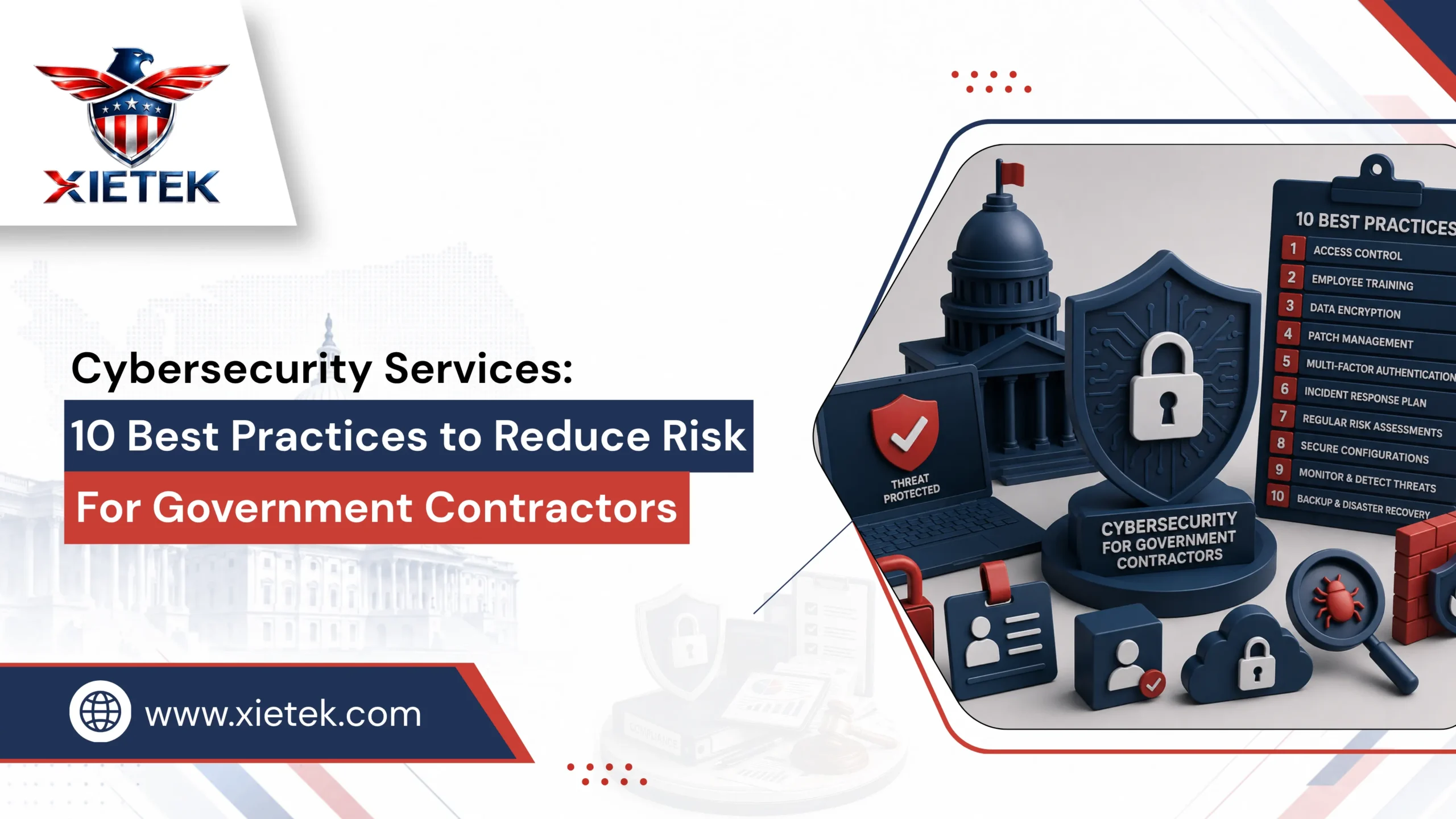
For government contractors, stronger security takes more than antivirus software or alerts after an attack. Instead, contractors need to understand their risks, protect important systems and data, watch for threats, prepare for incidents and improve their security over time. Here are 10 practical cybersecurity best practices that can help government contractors reduce risk and build a stronger security environment.
Start With a Cybersecurity Risk Assessment
You cannot protect systems and data if you do not know where they are or what risks they face. A cybersecurity risk assessment gives contractors a clear view of their current security. It can help identify important systems, sensitive information, security weaknesses, access risks and areas that need attention.
Start with a few basic questions: Which systems support our contracts?
Where do we store sensitive government information? Who can access it? Which applications and devices connect to our network? Which weaknesses could affect important operations?
The goal is not to create a long list of technical problems. Instead, the assessment should show which risks could cause the most harm. Contractors can then focus their time and budget on those areas first. A good risk assessment can also help connect security plans with business needs and contract requirements. The National Institute of Standards and Technology’s NIST Cybersecurity Framework 2.0 gives organizations a flexible way to understand, assess, prioritize and communicate cybersecurity risk.
Protect Sensitive Government Data
Government contractors may handle information that needs stronger protection than normal business data. For this reason, data security is a key part of federal contractor cybersecurity. Start by finding where sensitive information is created, received, stored, processed and shared. Then review who can access that information and why. Strong access controls, encryption, secure file storage, data classification, controlled sharing, regular access reviews and secure backups can all help protect important data.
Access should also change when an employee changes roles or leaves the company. Contractors should remove access that a person no longer needs. Regular access reviews can help reduce unnecessary permissions. In addition, contractors should train employees on safe data handling. External attacks are not the only source of risk. Poor access controls and careless handling of information can also expose sensitive data.
Make Multi-Factor Authentication Standard
Passwords alone do not provide enough protection for many modern systems. Multi-factor authentication, or MFA, adds another layer of security. It asks users to provide more than one form of verification before they gain access. For example, a user may need a password and a verification code, security key, or authentication app.
Contractors should prioritize MFA for accounts that provide access to government-related systems, administrative tools, cloud platforms, email, remote access services, security tools and sensitive business applications. In addition, CISA lists MFA as an important security practice for reducing common cyber risks. Strong MFA can make it harder for attackers to use stolen login details to enter systems that contain sensitive information.
Keep Systems and Software Updated
Attackers often search for weaknesses in old operating systems, applications, network devices and other technology. Regular updates can reduce the time that known security weaknesses remain open. A strong patch process should track the systems and applications in use, their current versions, available updates, urgent security issues and the people responsible for applying those updates.
However, keeping everything updated can become harder as a company grows. Contractors may use cloud platforms, employee devices, servers, third-party applications and specialized systems at the same time. Automated tools can help teams find outdated software and security weaknesses. Most importantly, contractors should focus first on weaknesses that could create the greatest risk to important systems and data.
Monitor Your Environment Continuously
Cyber threats can happen at any time. A strange login late at night, an unusual file transfer, or several failed login attempts may signal a security problem. As a result, cybersecurity monitoring services can help contractors spot suspicious activity sooner.
Continuous monitoring can identify unusual login activity, suspicious network behavior, malware signs, unauthorized access, unusual data movement, repeated failed logins, endpoint alerts and possible security incidents. For contractors without a large internal security team, managed cybersecurity services can provide ongoing monitoring and threat detection. This support can help teams investigate unusual activity sooner and reduce the possible impact of an attack.
Secure Your Cloud Environment
Cloud platforms can make business operations more flexible. However, moving data and applications to the cloud does not automatically make them secure. Contractors should know where their data is stored, who can access it, how users are verified and how the company monitors security events.
Cloud security services can help contractors protect identity and access controls, cloud settings, data, applications and connected systems. They can also support encryption, logging, monitoring, vulnerability management, backups and recovery. At the same time, contractors should look across their entire cloud environment. One secure platform cannot protect the company if another cloud service has weak settings or gives users more access than they need.
Test Your Defenses With Penetration Testing
Security tools can find possible weaknesses, but testing can show how those weaknesses may affect the business. Cybersecurity penetration testing uses authorized tests to examine systems, applications, networks and other environments for security gaps. Depending on the company’s needs, testing may cover external systems, internal networks, web applications, cloud environments, remote access systems and authentication controls.
The goal is not simply to find security weaknesses. Instead, testing helps contractors understand which weaknesses could cause the most harm. Qualified professionals should plan each test with clear permission and a defined scope. For government contractors, regular testing can also support broader security assessments and help confirm that important security controls work as expected.
Prepare a Cyber Incident Response Plan
No organization can guarantee that a cyber incident will never happen.
The more useful question is: What will your team do when an incident occurs?
A cyber incident response plan gives employees clear steps to follow. It should explain who leads the response, how the team identifies an incident, how it isolates affected systems, who needs to know, how it protects evidence and how it restores business operations.
Without a plan, employees may waste valuable time deciding what to do during a crisis. Therefore, contractors should test their response plans before a real incident occurs. Tabletop exercises and simple simulations can help employees understand their roles. A faster response can help the organization contain the problem, protect important information, restore operations and reduce the damage caused by an incident.
Train Employees to Recognize Cyber Threats
Technology is only one part of cybersecurity. Employees use email, applications, cloud platforms, files, devices and external communication tools every day. A single stolen account can create a serious security problem. For this reason, security training should teach employees how to spot phishing emails, suspicious attachments, fake MFA requests, social engineering attempts, unsafe file sharing and other common threats.
Training should not be a once-a-year activity. Short and regular training can help employees remember what to look for and how to respond. Contractors should also make it easy for employees to report suspicious activity. As a result, security teams can learn about possible threats sooner and take action before a small problem becomes a larger incident.
Build Security Into Your Architecture and Business Strategy
Contractors should think about security when they plan new systems, rather than add it after deployment. Security Architecture Consulting can help organizations build systems with security needs in mind from the start. This work may include reviewing network design, cloud infrastructure, identity management, applications, data flows, access controls, endpoint protection, monitoring and business continuity.
Security should also support the company’s larger business goals. For government contractors, cybersecurity can affect contract performance, customer trust, business continuity, compliance needs and future opportunities. NIST’s CSF 2.0 also treats cybersecurity risk as a responsibility across the organization, rather than an issue for the IT team alone.
What Government Contractors Should Prioritize First
Contractors do not need to introduce every security measure at the same time. Instead, start with the risks that matter most to the organization. First, identify important systems, data, users, security weaknesses and critical assets. Next, protect them with strong access controls, MFA, updates, encryption and data protection. Then, monitor the environment so your team can spot suspicious activity quickly.
After that, establish clear response steps and assign responsibilities before an incident occurs. Finally, maintain reliable backups and recovery plans so the company can restore operations after an attack. These steps follow the general approach used by CISA’s Cybersecurity Performance Goals. However, the right priorities will depend on each contractor’s systems, contracts, data and security risks.
A Practical Approach to Cybersecurity Priorities
A useful way to approach cybersecurity is to connect security decisions with business risk. For example, a contractor that handles sensitive government information may need to give data protection and access controls immediate attention. Another organization may need to focus first on cloud security, monitoring, or incident response. By starting with the highest risks, contractors can make better use of their security budget and resources.
When Should Government Contractors Consider Professional Cybersecurity Services?
Managing cybersecurity internally can become difficult as a company grows. For example, a contractor may need to manage security monitoring, risk assessments, cloud systems, penetration testing, incident response and compliance needs at the same time. Professional cybersecurity services can help when a contractor handles sensitive government information, prepares for a security assessment, needs stronger monitoring, lacks dedicated security staff, moves systems to the cloud, or needs help finding security gaps.
Cybersecurity consulting services can help contractors review their current security and create a practical plan for improvement. Meanwhile, managed cybersecurity services can provide ongoing monitoring and threat detection. Other services, such as penetration testing, risk assessments, cloud security and incident response, can address specific security needs. The right mix depends on the contractor’s systems, risks, resources and contract requirements.
Frequently Asked Questions
Government contractors may have access to sensitive government information, systems and mission-related data. As a result, a cyber incident can affect contract performance, business operations, customer trust, and compliance needs.
Contractors should focus on strong access controls, MFA, vulnerability management, data protection, monitoring, employee training, incident response, cloud security, security testing, and regular risk assessments.
A cybersecurity risk assessment helps an organization identify important systems and information. It also looks at possible threats and security weaknesses. Based on those findings, the contractor can decide which security improvements need attention first.
Managed cybersecurity services provide ongoing security support. This support may include monitoring, threat detection, vulnerability management, and incident assistance. Such services can help organizations that do not have enough internal staff to manage every security task.
The need for penetration testing depends on the contractor’s systems, contracts, security needs, and risk level. When appropriate, penetration testing can help find and validate weaknesses that other security checks may miss.
Cyber incident response is the process an organization uses to identify, contain, investigate, respond to, and recover from a cybersecurity incident.
Many contractors use cloud platforms for applications, storage, collaboration, and other business needs. Therefore, weak cloud settings, excessive user access, poor identity controls, and limited monitoring can create security risks. Strong cloud security should form part of the contractor’s wider security program.
Cybersecurity consulting services can help contractors review their security, find gaps, rank risks, improve security architecture, prepare for assessments, and create practical plans to strengthen their cyber defenses.
Strengthen Your Cybersecurity With XieTek LLC
XieTek LLC provides Cybersecurity Services designed to help government contractors strengthen their security posture, reduce cyber risk, and protect the systems and information that support their operations.
From cybersecurity risk assessments and managed monitoring to cloud security, penetration testing, security architecture, and cyber incident response, our team can help organizations address security needs across their technology environment.
Ready to strengthen your cybersecurity posture? Contact XieTek LLC today to discuss your cybersecurity needs and build a stronger defense against evolving threats. Explore XieTek LLC’s Cybersecurity Services and take the next step toward a more secure and resilient organization.