The connected device causing your next IT problem may not be offline. It may be online, working normally and no longer have a clear owner.
Connected cameras, environmental sensors, access systems and other IoT equipment can remain inside federal facilities and program networks for years. During that time, vendors change, software ages, responsibilities shift and remote connections accumulate.
On August 31, 2026, NIST published a Pre-Draft Call for Comments to begin revising SP 800-213A, IoT Device Cybersecurity Guidance for the Federal Government: IoT Device Cybersecurity Requirement Catalog. NIST is considering lessons learned, changes in the IoT threat landscape and whether its guidance should expand from individual devices to broader IoT products. Comments are due October 15, 2026. For government contractors, this evolving NIST IoT guidance offers a useful opportunity to review how connected equipment is managed across federal facilities and program environments.
In this blog, we examine what NIST’s review means for government contractors and how stronger IoT device management can improve asset visibility, maintenance, cybersecurity and reliable program operations.
NIST Is Reconsidering the IoT Security Boundary
The existing SP 800-213A catalog provides IoT device cybersecurity capabilities and non technical supporting capabilities that organizations can use when establishing cybersecurity requirements. NIST’s revision process is considering whether that scope should expand from individual devices to IoT products, along with emerging use cases and component deployments.
That direction aligns with NIST’s June 2026 draft revision of SP 800-213, which describes an IoT product as a system element and notes that adding one to an information system may change its risk assessment. For contractors, the practical lesson is that connected equipment should be understood in the context of the systems, applications and services required to operate it.
Start With an Inventory That Shows What Matters
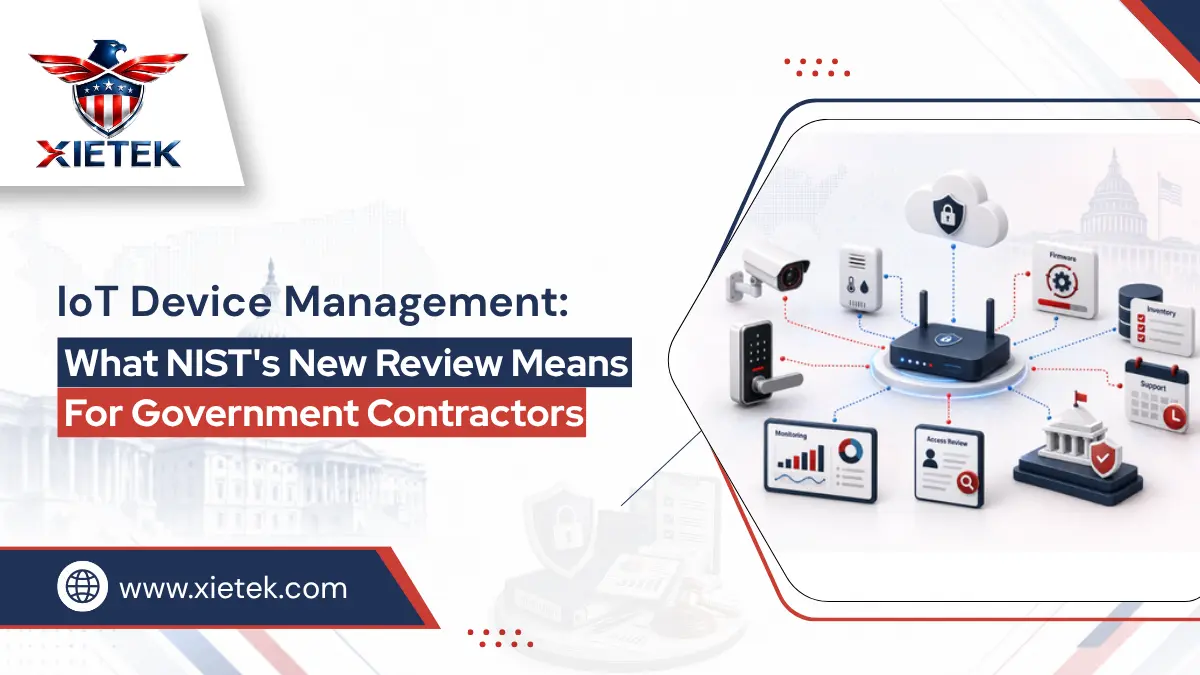
A basic asset list may identify a camera by manufacturer, model and location. A useful IoT inventory goes further. IT teams should capture the device’s purpose, owner, network connection, firmware version, support status and important dependencies such as gateways, management applications or backend services.
This matters where connected equipment supports physical security, environmental monitoring, facility operations or CUI supporting environments. Contractors should also distinguish government furnished from contractor acquired equipment where relevant. They should confirm whether maintenance, monitoring and replacement responsibilities are documented in the contract, system security documentation or supporting operating procedures.
Assign Ownership Across Contractor and Vendor Boundaries
IoT responsibility can become fragmented. Facilities may use the equipment, IT may manage connectivity, a subcontractor may support an application and the manufacturer may control firmware or cloud services.
Each device class or connected system should have a documented operational owner. Teams should know who tracks health, coordinates updates, maintains vendor relationships, reviews access and starts replacement planning. Clear ownership also helps during customer or security reviews when teams need to explain who maintains an asset or how an issue is being handled.
Track Vendor Support Before Devices Become a Liability
IoT equipment can remain physically functional after software support ends. A camera, sensor or controller may keep operating even when the manufacturer no longer provides firmware updates, security fixes or technical assistance.
Record vendor support periods during acquisition and review them throughout the asset lifecycle. When support nears its end, IT leaders can plan replacement, isolation, reduced exposure or another risk based response before an urgent problem appears, especially when equipment supports program uptime or contract delivery.
Make Firmware Updates Part of Managed Maintenance
IoT patching is rarely as uniform as endpoint patching. One device may update automatically, another may require manual firmware installation and another may depend on a vendor managed platform.
For each device class, contractors should know how updates are received, who reviews them, who authorizes deployment and how successful installation is verified. Maintaining version and update records gives teams useful evidence during troubleshooting and security reviews.
Review Remote Access and External Connections
Remote administration can simplify support across distributed facilities, but it can also leave unnecessary access paths in place. Contractors should understand which employees, subcontractors, vendors and service providers can remotely reach connected equipment and whether that access is still required.
Review authentication methods, privileges, inactive accounts and vendor connections periodically. When a vendor relationship or support model changes, associated access should be reviewed rather than left active by default.
Monitor Devices as Part of Network Operations
An accurate inventory tells IT teams what should be present. Monitoring helps determine whether those assets continue to operate as expected. Depending on the environment, teams may need visibility into device availability, repeated failures, unexpected communications or other changes that could indicate an operational or security issue.
Monitoring should reflect the role and risk of the equipment. A low impact sensor may require less oversight than a system supporting facility security or a network where CUI is handled. The objective is enough visibility to recognize changes before they become prolonged outages or unmanaged risks.
Use NIST’s Review as a Management Checkpoint
NIST’s August review does not establish a new universal compliance requirement for government contractors. The agency is requesting public input before developing the revision and applicability still depends on the relevant contract, system, agency requirements and other cybersecurity obligations.
Although NIST has not yet published the revised catalog, its review questions provide a useful reason for contractors to evaluate how connected products are inventoried, supported and governed today. The recommendations in this blog apply NIST’s direction to practical IT management rather than treating each recommendation as a new NIST requirement.
IoT Device Management Checklist
Use these seven questions to identify connected equipment that may need attention:
1. Inventory: Can you identify every relevant IoT device and the applications, gateways or backend services it depends on?
2. Ownership: Is a specific person or team accountable for maintenance and coordination throughout the device lifecycle?
3. Support: Is the manufacturer’s software, firmware and technical support period documented and still active?
4. Firmware: Are current versions tracked, updates managed through a defined process and successful installations verified?
5. Remote access: Can you identify every external connection, vendor account or remote management path and is each still necessary?
6. Monitoring : Can IT teams detect meaningful changes in device availability, connectivity or behavior?
7. Replacement: Is there a plan for equipment that becomes unsupported, obsolete or incompatible with program requirements?
A device that fails one of these checks is not automatically insecure. It indicates an ownership, maintenance or visibility gap that deserves review.
Bottom Line
NIST’s SP 800-213A review gives government contractors a timely reason to examine connected equipment before unclear ownership, expired support or unmanaged access creates a larger problem. Strong IoT device management means knowing what is deployed, who owns it, how it is maintained and when it should be replaced.
For federal contractors, that visibility can support reliable program operations and clearer evidence during customer or security reviews.
Frequently Asked Questions
NIST has started a revision of its IoT cybersecurity requirement catalog. The review is considering IoT products, emerging use cases, component deployments and additional guidance sources.
No. The review itself does not create a universal contractor requirement. Applicability depends on the relevant contract, system, agency requirements and other cybersecurity obligations.
Track the device, purpose, owner, location, network connection, manufacturer, model, firmware, vendor support status and important applications, gateways or backend dependencies.
Unsupported devices may stop receiving security fixes or technical assistance. Tracking support timelines gives IT teams time to plan replacement or another appropriate risk response.
Assess the device’s operational role, connectivity, exposure and available safeguards. Depending on risk and applicable requirements, teams may need to replace, isolate, restrict or otherwise manage the equipment.
Strengthen IoT Management Across Your IT Environment
XieTek LLC provides Managed IT Services that help organizations maintain asset visibility, coordinate technology maintenance and monitor the networks supporting connected equipment. Our team helps bring devices, dependencies, vendor access and lifecycle planning into a more consistent operating model.
Need better visibility into the connected equipment supporting your operations? Contact XieTek LLC to explore Managed IT support for asset management, coordinated maintenance and reliable network operations.